This complete guide explains how homestead exemptions protect home equity in bankruptcy, covering 2025 federal exemption amounts, state exemptions, and strategic differences between Chapter 7 and Chapter 13 filings.
Updated 9/16/2025
Why Trust Us?
Fact-Checked
Nolo was born in 1971 as a publisher of self-help legal books. Guided by the motto “law for all,” our attorney authors and editors have been explaining the law to everyday people ever since. Learn more about our history and our editorial standards.
Each article that we publish has been written or reviewed by one of our editors, who together have over 100 years of experience practicing law. We strive to keep our information current as laws change. Learn more about our editorial standards.
The homestead exemption protects or "exempts" equity in your residential home in bankruptcy. Almost every state has a homestead exemption you can use to protect your home's equity from creditors, and a federal homestead exemption also exists. Your state determines whether you must use the state homestead exemption or whether you can opt to use the federal homestead exemption instead.
In this article, you'll learn how the homestead exemption works, when you'll qualify to use a particular state's homestead exemption, how to determine your homestead exemption amount, and other factors you should know about filing for bankruptcy with equity in your home.
In This Article
- 2025 Federal Bankruptcy Exemption: Key Changes and Strategic Impact
- Choosing Between Federal and State Homestead Exemptions: When and How Much You Can Protect
- How to Research Your State's Homestead Exemption Laws
- Homestead Exemptions and Your Mortgage: Chapter 7 vs. Chapter 13 Bankruptcy
- Homestead Exemption Limitations and Requirements
- Common Homestead Exemption Mistakes to Avoid
- Step-by-Step Homestead Exemption Implementation
- Homestead Exemption in Bankruptcy FAQs
- Need More Bankruptcy Help?
2025 Federal Bankruptcy Exemption: Key Changes and Strategic Impact
Every three years, the federal bankruptcy exemption amounts increase, with the most recent occurring on April 1, 2025, and applying to cases filed between April 1, 2025, and March 31, 2028. (11 U.S.C. § 522.)
The 2025 federal exemption amount increase affects the homestead exemptions and home equity protection:
- Homestead exemption. Increased from $27,900 to $31,575. This is the amount of equity you can protect in your primary residence.
- Wildcard exemption. Increased from $1,475 to $1,675. You can apply this exemption to any property.
- Unused homestead wildcard exemption. Increased from $13,950 to $15,800. If you don't use the homestead exemption to protect home equity, you can use this amount to protect any property of your choosing.
Not all bankruptcy filers qualify to use federal bankruptcy exemptions. Instead, they are limited to using state bankruptcy exemptions. Check for the bankruptcy exemptions available to protect your property.
Choosing Between Federal and State Homestead Exemptions: When and How Much You Can Protect
When determining how much home equity you can protect, you'll begin by reviewing your state's homestead exemption amount and determining whether your state will allow you to choose between the state and the federal exemption system.
If given a choice, select your list carefully. Because you can't select exemptions from both sets, the exemption list you choose will impact not only your home equity, but all other property you own.
Consider choosing federal exemptions when:
- Your home equity is under $31,575. The federal homestead exemption can fully protect your home if your equity falls within this limit.
- Your personal property exceeds state limits. The federal system offers a powerful wildcard exemption that allows you to protect $1,675 in any property, plus up to $15,800 of unused homestead exemption.
- Your state's homestead exemption is lower than $31,575. For example, states like Kentucky and Tennessee have lower homestead exemption amounts.
Consider choosing state exemptions when:
- Your state offers unlimited homestead protection. States like Texas, Florida, Iowa, Kansas, Oklahoma, South Dakota, Arkansas, and Washington D.C. provide unlimited or very high homestead protection, making them ideal if your home equity is substantial. (Unlimited protection is subject to acreage limitations and other residency requirements.)
- Your home equity exceeds the federal exemption amount. If your equity exceeds the federal exemptions, using your state exemption might be your best option.
- Your state offers high-value homestead exemptions. Some states provide significant homestead exemption protection, such as California, Nevada, or Massachusetts.
- Your state's exemption system better matches your assets. Beyond the homestead, some states might offer better protection for other types of property you own.
Example. A Texas resident with $100,000 in home equity should consider state exemptions due to the unlimited home equity protection provided, versus the $31,575 federal homestead protection.
Example. A Massachusetts resident with $40,000 in home equity and a $15,000 boat might benefit more from the flexibility provided by the federal exemption wildcard and be able to protect an asset that would typically be nonexempt.
How to Research Your State's Homestead Exemption Laws
Below you'll find links to state-specific homestead exemption articles.
You'll also want to review all the bankruptcy exemptions allowed by your state. It's essential to read the actual exemption laws, as you must meet specific requirements to qualify.
If you find it difficult to verify current exemption amounts, you're not alone. Many states don't update the exemption amount in the law itself. A local bankruptcy attorney can provide the current homestead amount and explain what you must do to protect your home and other property in bankruptcy.
Homestead Exemptions and Your Mortgage: Chapter 7 vs. Chapter 13 Bankruptcy
You might find that you can't protect all your home equity with a homestead exemption, a wildcard exemption that allows you to protect any property of your choice, or a combination of the two. In that case, you'll need to know whether you should file for Chapter 7 or 13 to keep your home.
Chapter 7 Homestead Exemption Treatment
In Chapter 7 bankruptcy, you lose a home with nonexempt equity. The Chapter 7 trustee can sell it if the available exemptions in Chapter 7 aren't adequate to protect it. The trustee distributes the sale proceeds to creditors after paying your exemption amount, paying off the mortgage and liens, covering sale costs, and subtracting the trustee's fee.
Chapter 7 mortgage payment requirements. You won't lose your home in Chapter 7 if you meet all requirements. Other than exempting home equity, you should also be aware that, in Chapter 7, to avoid foreclosure, you must be current on your mortgage payments and remain current after filing for bankruptcy. If you are behind on payments, the lender might seek relief by asking the court to lift the automatic stay—the injunction order that stops collection actions when you file for bankruptcy—and allow the lender to foreclose. These motions are usually granted.
Example. Sarah owns a home worth $150,000. Because it has a $100,000 mortgage, she has $50,000 in home equity. Her state allows her to choose the federal bankruptcy exemptions. However, because the $31,575 federal homestead exemption wouldn't fully protect the home equity, she'd lose the home unless her state's homestead and wildcard exemptions would protect $50,000 or more in home equity.
Tip. If you're behind on mortgage payments and want to keep your home, consider filing for Chapter 13 bankruptcy. It provides more home retention strategies.
Chapter 13 Homestead Exemption Treatment
In Chapter 13 bankruptcy, you can keep your home even if you have nonexempt equity, as long as you can afford to pay for the nonexempt equity by making payments to the Chapter 13 trustee through your repayment plan.
Chapter 13 mortgage payment requirements. Chapter 13 is often used to keep a house by debtors who are behind on mortgage payments and want to keep their home. The Chapter 13 plan can include provisions to catch up on missed payments over time, while also requiring you to stay current on future payments.
Example. Suppose we use Sarah's scenario again and learn that her state homestead exemption is less than the federal homestead exemption. In Chapter 13, she could pay $18,425, the difference between the $31,575 federal homestead exemption and her $50,000 equity over the life of the Chapter 13 plan, and keep the house. That would be approximately $307.00 per month for 60 months in addition to her regular monthly mortgage payment, and any other amounts required in Chapter 13.
Homestead Exemption Limitations and Requirements
All exemptions have exclusions that restrict use, so you must verify that your property qualifies for a particular exemption's use. We outline some rules below that you should be aware of. A local bankruptcy lawyer can explain all the requirements you must meet to protect your home.
Using Wildcard Exemptions to Increase Home Equity Protection
Homestead exemptions aren't always sufficient to protect all of a homeowner's equity. Check whether your state offers a wildcard exemption that allows you to exempt any property of your choice. The federal exemptions offer a wildcard exemption.
In many instances, you can stack the wildcard exemption on top of your homestead exemption, increasing the total protectable amount. However, some states limit a wildcard's use by precluding real estate or cash.
40-Month Domicile Rule for State Homestead Exemptions
Federal law restricts homestead exemptions to prevent people from shielding their assets by moving to states with unlimited homestead exemptions shortly before filing for bankruptcy. You must have purchased your home at least 40 months before filing for bankruptcy to qualify for more than $214,000 of the state's homestead exemption. (11 U.S.C. 522(p); amounts apply to cases filed between April 1, 2025, and March 31, 2028.)
However, an exception exists. If you sold your home and bought a new one with the sale proceeds in the new state, the time you owned your first home will count toward the 40-month requirement.
Example. Juan's Texas home is worth $400,000 and has a $150,000 mortgage, leaving $250,000 in home equity. Although the Texas homestead protection is unlimited, Juan has owned his home for 30 months and can't meet the 40-month domicile requirement. If he files for bankruptcy, the homestead exemption will be capped at $214,000, leaving him $36,000 of nonexempt equity.
Homestead Exemption Caps for Fraud and Criminal Activity
Your homestead exemption is also capped at $214,000 if you have committed bankruptcy fraud or other crimes. (11 U.S.C. 522(q); amounts apply to cases filed between April 1, 2025, and March 31, 2028.) Learn more about bankruptcy fraud and the consequences of bankruptcy fraud.
Example. Liam was convicted of bankruptcy fraud after attempting to hide assets. As a result, he can only protect $214,000 of equity in his Nevada home worth $750,000, leaving $536,000 of nonexempt equity to pay creditors after the trustee sells it in Chapter 7 bankruptcy.
How to Claim Your Homestead Exemption in Bankruptcy
You use a homestead exemption the same way you use other bankruptcy exemptions. Bankruptcy exemptions protect some of your property from creditors. You'll list your property and the exemptions protecting it in the bankruptcy forms you include in your bankruptcy petition.
Common Homestead Exemption Mistakes to Avoid
Steering clear of these practices will help avoid issues and holdups in your bankruptcy case.
Converting Nonexempt Assets to Protected Home Equity
Converting significant assets into home equity immediately before filing can trigger scrutiny for bankruptcy fraud. Courts examine whether conversions were made in good faith or specifically to hinder creditors. Consult with a bankruptcy attorney before making any significant financial decisions.
Mixing Federal and State Exemptions
You can't pick and choose exemptions from federal and state lists. If you select federal exemptions, you must use the entire federal exemption scheme. If you choose state exemptions, you're limited to that state's exemption list plus any federal nonbankruptcy exemptions.
Failing to Meet Residency Requirements
Moving states shortly before bankruptcy can severely limit your exemption options. You might be required to use federal exemptions or those from your previous state of residence, both of which might be less favorable than those of your new state.
Homestead Exemption Objections
Trustees or creditors might object to homestead exemptions based on several factors, including an overvaluation of the property, failure to meet residency requirements, questions about the primary residence status, and fraudulent transfers or conversions.
You can prepare for potential challenges in the following ways:
- obtain recent property appraisals
- document residency with utility bills, voter registration, and tax returns
- maintain records of property improvements, and
- work with a qualified appraiser.
Step-by-Step Homestead Exemption Implementation
Completing this three-part process before you file will help you protect your home in bankruptcy.
- Make sure you qualify for the bankruptcy chapter of your choice.
- Gather documents needed for bankruptcy, including deeds, mortgage statements, tax records, and utility bills for proof of ownership, the amount you owe, and the length you've lived there.
- Get an appraisal or a real estate agent's estimate of your home's value.
- Determine your home's equity by subtracting what you owe.
- If you haven't owned your home for over 3 years, 4 months, check whether your equity exceeds the 40-month cap.
- Decide whether federal or your state's exemptions protect more of your assets.
- Avoid last-minute transfers of assets into your home.
- Actually live in the home.
- If filing Chapter 7, ensure that mortgage payments are up to date.
- Complete Schedule C in your bankruptcy paperwork along with other forms.
Following these steps can help ensure your homestead exemption is correctly claimed and protects your home.
Homestead Exemption in Bankruptcy FAQs
Below you'll find answers to common questions about protecting a home in bankruptcy using a homestead exemption.
- What is the federal homestead exemption amount for 2025?
- Can I use both federal and state homestead exemptions together?
- How long do I need to live in a state to use its homestead exemption?
- What is the $214,000 homestead exemption cap, and when does it apply?
- What happens if my home equity exceeds the homestead exemption limit?
- How does the wildcard exemption work with homestead exemptions?
- Can I protect a mobile home or manufactured home with the homestead exemption?
- Can married couples double their homestead exemption amount?
- What states allow unlimited homestead exemptions in bankruptcy?
- How do I choose between federal and state bankruptcy exemptions?
- Can I convert assets to home equity before filing bankruptcy?
- What is the domicile requirement for homestead exemptions?
- Do homestead exemptions protect vacation homes or rental properties?
- How do homestead exemptions work differently in Chapter 7 vs Chapter 13?
What is the federal homestead exemption amount for 2025?
The federal homestead exemption allows you to protect up to $31,575 in home equity as of 2025.
Can I use both federal and state homestead exemptions together?
No, you can't mix and match. You must choose either the complete set of federal exemptions or your state's bankruptcy exemptions.
How long do I need to live in a state to use its homestead exemption?
You must have purchased your home at least 40 months before bankruptcy to qualify for the state's full homestead exemption. Otherwise, the amount you can exempt will be capped.
What is the $214,000 homestead exemption cap, and when does it apply?
This cap applies if you don't meet the 40-month domicile rule or if you've committed bankruptcy fraud or other crimes.
What happens if my home equity exceeds the homestead exemption limit?
In Chapter 7, the trustee is likely to sell the home. In Chapter 13, you can keep your home by paying the nonexempt equity through your repayment plan.
Do I lose my homestead exemption if I'm behind on mortgage payments?
No, the exemption itself isn't lost, but if you're behind on payments, the lender can still foreclose, especially in Chapter 7. Chapter 13 allows you to catch up on payments through the plan so you don't lose the house.
Can I protect a mobile home or manufactured home with the homestead exemption?
Although the homestead exemption generally applies to real property you use as your primary residence (a home fixed to the land), exceptions exist. Most states specify whether you can apply the homestead exemption toward personal property used as your primary residence, such as a mobile or manufactured home. You can find out by reading your state's homestead exemption statute.
How does the wildcard exemption work with homestead exemptions?
Some states allow you to stack the state's wildcard exemption on top of the homestead exemption to increase protection. However, you must read the statute. Some states limit what you can use the wildcard to protect. For instance, many don't allow you to protect cash in bankruptcy using the wildcard. Others don't allow its use on real estate, like your home.
Can married couples double their homestead exemption amount?
Yes, married couples can double the federal homestead exemption amount. However, not all states allowed joint filers to double the state homestead exemption. You'll want to consult your state's exemption laws.
What states allow unlimited homestead exemptions in bankruptcy?
Texas, Florida, and Iowa are three states offering unlimited or high homestead protection. Check your state homestead exemption statute for the amount of home equity you can protect in your state.
How do I choose between federal and state bankruptcy exemptions?
Ultimately, it will depend on which exemption set protects the property you'd most like to keep.
Can I convert assets to home equity before filing bankruptcy?
While possible, this can be risky, so you'd want to consult with a local bankruptcy attorney before proceeding. Depending on the particular facts, converting nonexempt assets to exempt assets can be seen as illegal asset protection.
What is the domicile requirement for homestead exemptions?
You must have purchased your home at least 40 months before bankruptcy to qualify for a state's full homestead exemption. If your equity is less than $214,000, and the homestead exemption you're using fully protects it, this shouldn't be an issue, but discuss the concern with your bankruptcy lawyer.
Do homestead exemptions protect vacation homes or rental properties?
No, the homestead exemption protects equity only in your primary residence, which is the home in which you reside. However, a few states don't follow this rule quite as strictly, so review the homestead statute.
How do homestead exemptions work differently in Chapter 7 vs Chapter 13?
You're allowed to claim the same homestead amount regardless of the chapter you file. However, if you have nonexempt equity, you'll likely lose the home in Chapter 7. In Chapter 13, you pay nonexempt equity through a repayment plan to keep the home, as well as catch up on missed mortgage payments—two requirements for retaining a house in bankruptcy.
Need More Bankruptcy Help?
Did you know Nolo has made the law accessible for over fifty years? We wholeheartedly encourage research and learning, and you can find many more helpful bankruptcy articles on Nolo's bankruptcy homepage. These resources can explain what bankruptcy entails, what you should avoid before filing for bankruptcy, and more. Additionally, information needed to complete the official downloadable bankruptcy forms can be found on the Department of Justice U.S. Trustee Program website.
However, online articles and resources can't address all bankruptcy issues and aren't written with the facts of your particular case in mind. The best way to protect your assets in bankruptcy is by hiring a local bankruptcy lawyer.
In This Article
- 2025 Federal Bankruptcy Exemption: Key Changes and Strategic Impact
- Choosing Between Federal and State Homestead Exemptions: When and How Much You Can Protect
- How to Research Your State’s Homestead Exemption Laws
- Homestead Exemptions and Your Mortgage: Chapter 7 vs. Chapter 13 Bankruptcy
- Homestead Exemption Limitations and Requirements
- Common Homestead Exemption Mistakes to Avoid
- Step-by-Step Homestead Exemption Implementation
- Homestead Exemption in Bankruptcy FAQs
- Need More Bankruptcy Help?
DIY Legal Tools from Nolo
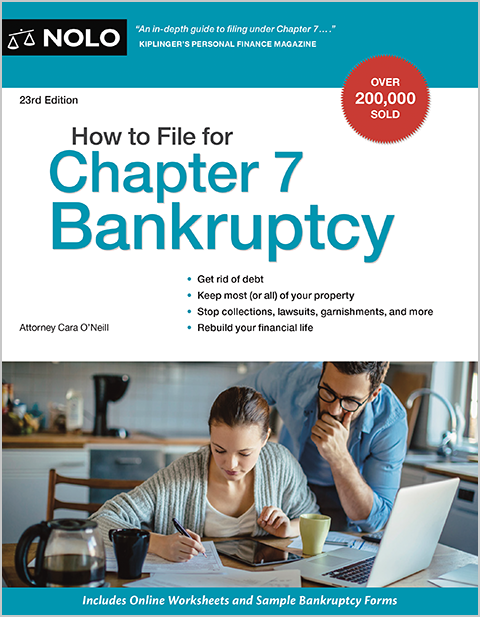
Book & eBook
How to File for Chapter 7 Bankruptcy
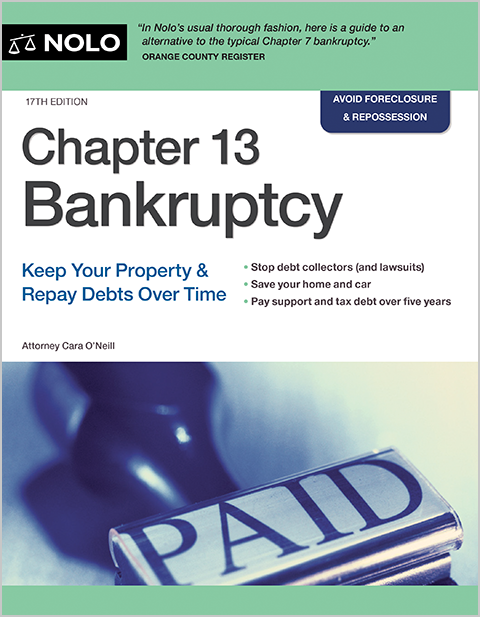
Book & eBook
Chapter 13 Bankruptcy

Copyright ©2025 MH Sub I, LLC dba Nolo ® Self-help services may not be permitted in all states. The information provided on this site is not legal advice, does not constitute a lawyer referral service, and no attorney-client or confidential relationship is or will be formed by use of the site. The attorney listings on this site are paid attorney advertising. In some states, the information on this website may be considered a lawyer referral service. Please reference the Terms of Use and the Supplemental Terms for specific information related to your state. Your use of this website constitutes acceptance of the Terms of Use, Supplemental Terms, Privacy Policy, Cookie Policy, and Consumer Health Data Notice.
Your Privacy Choices