Find out what you must prove to receive a hardship discharge in Chapter 13 bankruptcy and erase debts without completing your monthly payments.
Updated 5/15/2024
Why Trust Us?
Fact-Checked
Nolo was born in 1971 as a publisher of self-help legal books. Guided by the motto “law for all,” our attorney authors and editors have been explaining the law to everyday people ever since. Learn more about our history and our editorial standards.
Each article that we publish has been written or reviewed by one of our editors, who together have over 100 years of experience practicing law. We strive to keep our information current as laws change. Learn more about our editorial standards.
Getting a hardship discharge in Chapter 13 bankruptcy might be the solution you need if you can't complete your Chapter 13 repayment plan because of an unexpected event, such as a job loss. In this article, you'll learn how to file a motion asking the court for a Chapter 13 bankruptcy hardship discharge and what you must prove to qualify for it.
What Is a Chapter 13 Hardship Discharge?
In certain cases, a filer can end a Chapter 13 case early and eliminate qualifying debts by asking the court for a hardship discharge. However, receiving a hardship discharge isn't always possible, especially if you filed Chapter 13 to prevent losing property in Chapter 7. Below are the three factors you must demonstrate before receiving an early Chapter 13 discharge based on hardship.
How to Qualify for a Chapter 13 Hardship Discharge
Your first step will be filing a motion for a hardship discharge with the bankruptcy court. The court will grant your request for a hardship discharge if you can prove three conditions:
- Circumstances beyond your control. You failed to complete your plan payments due to circumstances "for which you should not justly be held accountable." You must show more than a temporary job loss or physical disability, and proving the permanence of your condition will likely be medical evidence.
- Unsecured creditors received adequate payment. Based on what you have already paid into the plan, your unsecured creditors have received at least what they would have received if you had filed for Chapter 7. For instance, suppose you couldn't protect $50,000 of home equity in Chapter 7, so you filed for Chapter 13 to prevent losing the home. You'd need to have already paid the $50,000 not covered by bankruptcy exemptions. This is typically a hard condition to meet unless you have little or no nonexempt property.
- Modification of your plan is not practical. To meet this requirement, you don't have to file and lose a motion to modify your plan payment. You just need to show the bankruptcy court that you don't have enough money to pay into a modified plan.
If you don't qualify for a hardship discharge, it's likely because you need to pay money to your unsecured creditors. If so, you can convert from a Chapter 13 to a Chapter 7 bankruptcy. The Chapter 7 trustee will sell your nonexempt property (assets you can't protect with a bankruptcy exemption) and distribute the funds to your creditors.
Debts a Hardship Discharge Won't Eliminate
If the court grants your motion for a hardship discharge, only unsecured nonpriority debts get discharged. The following debts typically aren't wiped out in a hardship discharge:
- priority debts (such as domestic support obligations and recent taxes)
- secured debts if you kept the property (for instance, a house or car payment)
- arrears on secured obligations
- debts not listed in your bankruptcy papers
- student loans
- most federal, state, and local taxes, as well as any amounts you borrowed or charged on a credit card to pay those taxes
- child support, alimony, and debts resulting from a divorce or separation decree
- fines or restitution imposed in a criminal-type proceeding
- liabilities for death or personal injury resulting from your intoxicated driving
- debts for dues or special assessments you owe to a condominium or cooperative association
- obligations you couldn't discharge in a previous bankruptcy due to fraud or misfeasance, and
- debts owed to a pension, profit-sharing, stock bonus, or other plan established under various sections of the Internal Revenue Code.
Debts a Hardship Discharge Won't Eliminate if the Creditor Objects Successfully
Some debts will be wiped out in a hardship discharge unless the creditor objects to the debt by filing and winning a lawsuit called an adversary proceeding. These debts include:
- debts incurred through fraudulent acts, including using a credit card when you knew you would be unable to pay the bill
- debts from willful and malicious injury you caused to another person or property, and
- debts from embezzlement, larceny, or breach of trust (fiduciary duty).
If you have a debt that falls into one of these categories, your best strategy is to do nothing and hope the creditor does the same. If the creditor files the lawsuit, you must respond if you want the debt to remain dischargeable.
DIY Legal Tools from Nolo
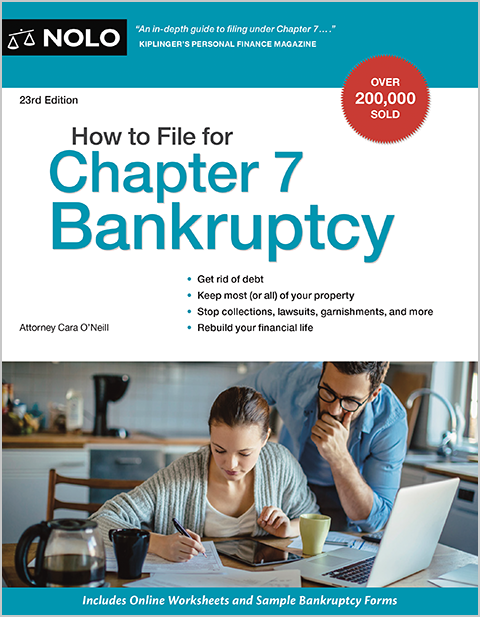
Book & eBook
How to File for Chapter 7 Bankruptcy
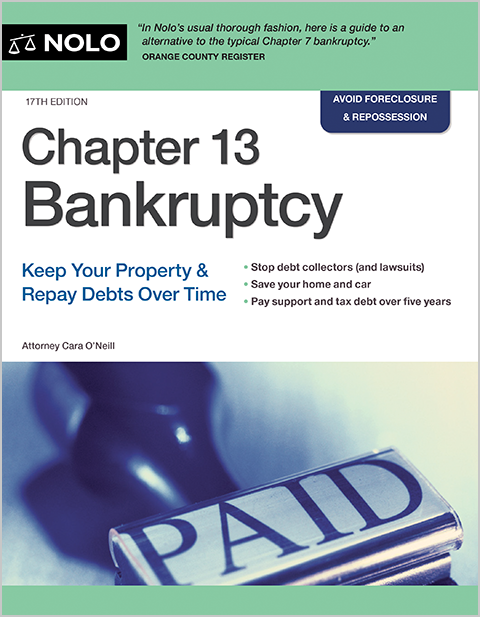
Book & eBook
Chapter 13 Bankruptcy

Copyright ©2025 MH Sub I, LLC dba Nolo ® Self-help services may not be permitted in all states. The information provided on this site is not legal advice, does not constitute a lawyer referral service, and no attorney-client or confidential relationship is or will be formed by use of the site. The attorney listings on this site are paid attorney advertising. In some states, the information on this website may be considered a lawyer referral service. Please reference the Terms of Use and the Supplemental Terms for specific information related to your state. Your use of this website constitutes acceptance of the Terms of Use, Supplemental Terms, Privacy Policy, Cookie Policy, and Consumer Health Data Notice.
Your Privacy Choices