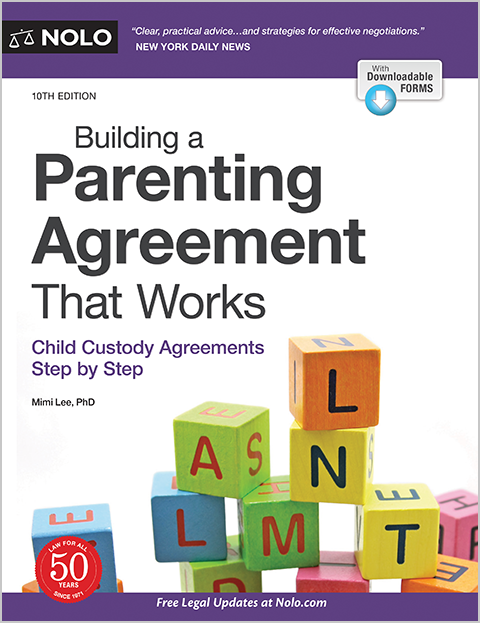
To understand possible child custody outcomes, you’ll want to learn about the types of custody, who makes decisions about the children, and what factors affect visitation rights.
Nolo was born in 1971 as a publisher of self-help legal books. Guided by the motto “law for all,” our attorney authors and editors have been explaining the law to everyday people ever since. Learn more about our history and our editorial standards.
Each article that we publish has been written or reviewed by one of our editors, who together have over 100 years of experience practicing law. We strive to keep our information current as laws change. Learn more about our editorial standards.
For many parents, figuring out child custody is one of the most difficult—and most important—parts of a divorce.
When children are involved, either the court must decide or the parents must agree on how to handle issues like whether and how custody will be shared, who will make decisions for the kids, and how visitation will work.
Here's an overview of key child custody information for divorcing parents, plus answers to some of the most frequently asked custody questions.
There's no one-size-fits-all custody arrangement. Your parenting plan should be tailored to meet the needs of your family.
The final custody order will normally address both physical custody (which parent the child lives with) and legal custody (either or both parents' right to make important decisions about the child's upbringing).
Most custody orders divvy up custody in one of the following ways:
sole legal custody and sole physical custody to one parent
sole physical custody and joint (shared) legal custody
sole legal custody and joint physical custody (rare).
When an order specifies that one parent has sole physical custody, the judge (or the parents, in a custody agreement) will typically create a visitation schedule to ensure the child has the opportunity to enjoy a meaningful relationship with the noncustodial parent. Similarly, shared physical custody orders will usually include a parenting time schedule
Who Decides Custody?
As is the case with most family law issues, judges will give a lot of weight to any agreements that parents reach regarding child custody. If parents can work together to achieve a fair and proper custody arrangement, the judge will likely adopt it into a court order. Working together is the best opportunity for parents to control what happens to their families after a separation or divorce.
If you can't reach an agreement on your parenting arrangements, a judge will decide for you, based on the evidence—including the results of any independent investigations the court has ordered (more on that below).
How Judges Make Custody Decisions
As a general rule, state custody laws place the highest priority in these decisions on the "best interests of the child." Most states require judges to consider a list of specific circumstances in the case when they're deciding what would be the child's best interests. Those factors vary from state to state, but they typically include:
the child's age, mental and physical health, and any special needs
each parent's mental and physical health
the emotional bond between the child and each parent, as well as any siblings
each parent's ability to meet the child's needs and provide a stable environment
each parent's willingness to encourage the child's relationship with the other parent
the child's ties to school, home, and community, and
any history of a parent's abuse of the child or the other parent.
The relative importance of some of these factors may vary depending on the child's age. For instance, some judges will favor awarding physical custody of a young child to the parent who's been the primary caregiver. With an older child, the best interests evaluation might lean in favor of the parent who can foster continuity in education, neighborhood life, religious life, and peer relationships. In states that allow consideration of children's custody preferences, judges are also more likely to listen to what older children want.
In tough child custody cases—such as those where one parent is claiming that the other is "unfit"—judges might order a child custody evaluation. Parents can request a custody evaluation even when a judge doesn't. A child custody evaluator can provide information and recommendations that will help the judge decide what's in the child's best interests.
How to Modify a Custody Arrangement
In nearly every state, maintaining stability for the child is one of the main priorities when judges are deciding custody matters. This strong preference for the status quo can make it difficult for parents to modify existing custody orders. But judges do understand that changing family circumstances might require updating the current orders.
Before a judge will consider modifying custody or visitation, the parent who's requesting a change usually must demonstrate that there's been a substantial change in circumstances. If the judge agrees to review the case, the parent will also have to show that the existing order no longer serves the child's best interests. when deciding whether to order a modification, the judge will consider the same factors and best-interests standards (discussed above).
No. Courts frequently award at least partial custody to both parents, called "joint custody." Joint custody takes one of three forms:
joint physical custody (children spend a substantial amount of time with each parent)
joint legal custody (parents share decision-making on medical, educational, and religious questions involving the children), or
both joint legal and joint physical custody.
In some states, like New Mexico, the law presumes that joint custody is in the child's best interests during initial custody proceedings, unless a parent can show that wouldn't be the case. (N.M. Stat. § 40-4-9.1 (2023).)
Are judges more likely to award custody to mothers than to fathers?
In the past, judges typically awarded the custody of children—especiallly young children—to the mother. Today, however, state laws require that custody decisions be based on what's best for the childre. A parent's gender isn't one of the factors that are considered. In fact, the laws in several states explicitly prohibit judges from awarding custody based only on a parent's gender.
If you are a father and want to ask the court for physical custody, don't let gender stereotypes stop you. If both you and the mother work full-time, and the kids have after-school care, you might be on equal footing when it comes to who is better situated to have physical custody. In fact, if you have more flexible hours than the mother, you might have an advantage. In any event, the judge will look at what's best for the children. So if you think you should have primary custody and can persuade the judge that would be in the kids' best interests, you should go ahead and ask for custody. If you present yourself as willing and able to parent, it will go a long way toward eliminating any lingering prejudice against you as a father.
Also, the reality is that most divorcing parents eventually agree on their custody arrangements, rather than having a judge decide for them. And judges usually approve these parenting agreements unless they're clearly not in the children's best interests. Some fathers simply agree that the mother should have primary physical custody for whatever reasons. But here again, fathers shouldn't simply give up on their desire to have the kids live with them, at least for a good chunk of time, just because they don't think they'll win in court.
Will it hurt your chances of getting custody if you move out and leave the kids with the other parent?
It might. If you simply move out and leave the children behind, a judge could interpret your move as a signal that the other parent is better suited to have permanent physical custody. Also, when the children stay in the family home, continue in the same school, and participate in their usual activities after a parent moves out, a judge might believe that a change in custody would be an unnecessary disruption in the children's routines.
If you must leave the family home and can't take the children with you, it would be best to have a written agreement with the other parent stating that the arrangement is temporary and won't affect permanent custody.
But that might not always be possible, such as when you've had to flee domestic violence. In that case, you should try to take the children with you and, as quickly as possible, file a motion (a formal written request) in family court for temporary custody and child support orders. If you don't do that, the other parent could claim that you've taken the children wrongfully. You could face criminal charges or at least an order from the court to return the children immediately (more below on custody enforcement).
Are there special issues if a gay or lesbian parent is seeking custody or visitation rights?
In most states, judges may typically consider a parent's sexual orientation in custody decisions only if it harms the child. Even in those states that include parents' "moral fitness" among the factors that go into the best-interests analysis, the courts (or the laws themselves) usually require judges to focus on whether a parent's behavior had a direct negative impact on the child.
However, LGBTQ parents who are in a custody dispute with a heterosexual ex may still experience discrimination from judges who can't set aside their own prejudices. Judges typically have a lot of leeway when making custody decisions, and some of them might might conceal their bias by citing issues other than a parent's sexual orientation to deny custody or appropriate visitation. Other judges might find that children would be harmed by living with a parent and that parent's new same-sex partner, because of the perceived social stigma of living in an LGBTQ household.
California law has addressed the potential for judicial discrimination by explicitly prohibiting judges from considering the sex, gender identity, gender expression, or sexual orientation of a parent when deciding what custody arrangements would be in the child's best interests. (Cal. Fam. Code § 3040(c) (2023).) But this type of broad antidiscrimination provision isn't typical across the country.
If you're involved in a custody case and are concerned about sexual orientation or sexual identity bias, make sure you consult a lawyer about protecting your rights. You can get attorney referrals from the National Center for Lesbian Rights.
Same-sex couples who are divorcing face different child custody issues. Even when they've agreed to raise a child together, the nonbiological parents might face hurdles in getting custody or visitation rights. State laws have traditionally presumed that when a child was conceived or born during a marriage, the mother's husband is the father. Many states still use gendered language in these laws, but the courts in a number of those states have held that the parenthood presumption applies to the wife of a mother who had a child during the marriage using assisted reproduction. (The situation is murkier for married men who had a child through surrogacy.)
Is race ever an issue in custody or visitation decisions?
It shouldn't be. In 1984, the U.S. Supreme Court ruled that it's unconstitutional for a judge to consider race when a noncustodial parent petitions for a change of custody. In that case, a white couple divorced, and the judge awarded custody of the couple's son to the mother. She remarried an Black man and moved to a predominantly African American neighborhood. The father filed a request to modify custody based on the changed circumstances from the marriage and the move. A Florida court granted the father's request, but the U.S. Supreme Court reversed, ruling that societal stigma, especially related to race, cannot be the basis for a custody decision. (Palmore v. Sidoti, 466 U.S. 429 (1984).)
Who determines how much visitation is reasonable and fair?
When a judge awards physical custody to one parent and "reasonable" visitation to the other, the parent with physical custody generally has the power to decide when and how much visitation is reasonable. In other words, unless the parents have a specific calendar or schedule, a noncustodial parent's visitation is often affected by the relationship between the parents.
Unfortunately, this type of order often means that the noncustodial parent has to fight for time with the child. To avoid this problem, many courts instead require parents to work out a fairly detailed parenting plan that includes a schedule for when each parent will have the child. When the parents can't agree, the judge will create a schedule for them to follow.
Many states or courts provide standard parenting schedules that provide for visitation with the noncustodial parent alternating weekends, school breaks, and holidays that occur during the school year, as well as significant visitation in the summer. However, it's a growing trend in some states for the default parenting plans to allow both parents to have close to equal time with their children.
What can you do if the other parent isn't obeying custody arrangements?
Parents don't always follow custody orders. Violations can range from being habitually late for scheduled pick-ups to withholding visitation—or even taking the children out of the state or the country to keep them from the other parent. If you believe your ex is guilty of a crime like parental kidnapping, you should report it to law enforcement. Otherwise, you'll have to go back to the family court to ask a judge to enforce your custody orders. The judge may simply require you to go to mediation or order your ex to comply with the orders. Then, if the problems continue, the judge might hold your ex in contempt of court, which could lead to a fine.
Keep in mind that you won't be able to get a judge to enforce your custody arrangement unless you already have a formal custody order, issued as part of a divorce or a legal separation proceeding (in states where that's available). If you and your spouse are separated and haven't started legal proceedings, you'll have no recourse if your spouse doesn't abide by an informal agreement about taking care of the children.
Is mediation the best approach to solving disagreements about child custody?
In child custody mediation, a trained, neutral professional (called a mediator) meets with parents to help them reach an agreement about custody and visitation. The mediator does not make decisions for the parties. Instead, the mediator facilitates negotiations and might suggest solutions. Mediation is confidential—what the parties say in mediation can't be used in court.
Courts in many states will require parents to participate in mediation of any custody disputes. Even when it's not required, mediation is usually a better option than litigation (fighting it out in court) for resolving custody and visitation disputes. That's because:
parents usually don't have to hire lawyers or expert witnesses, which translates to lower divorce costs
mediation usually results in a faster resolution to the disagreement—legal battles over child can drag on for months or even years, and
mediation encourages communication and makes it more likely that the parents will cooperate when future issues arise.
Experts who've studied the effects of divorce on children universally conclude that when divorcing or separating parents can cooperate, the children suffer less. And studies have shown that parents are more likely to be satisfied with their custody arrangements when they've reached them through an agreement rather than having a judge decide for them.
How do you get a custody order if you never married your child's other parent?
Unmarried parents may file a request for custody in family court. But before a judge will issue any custody orders, you'll probably need to get a court order establishing the child's paternity, unless both parents signed and submitted a voluntary paternity declaration shortly after the child was born. Your state's or tribe's child support enforcement agency will usually provide free assistance with establishing paternity.
Should I allow my ex to take our child out of the country?
Custody orders often include provisions that prohibit a parent from taking a child out of the state or country without the other parent's consent or a court order. Traveling to another state might be a normal part of a child's life, especially for vacations or family visits. But traveling out of the country can have serious consequences that you should consider, particularly if your child's other parent has family or other close contacts in that other country. If your ex decided to stay abroad with your child, you would need to pursue legal action under international child custody law. That would probably be expensive and take a long time—and it would only be possible if the other country is a signatory of the Hague Convention on the Civil Aspects of International Child Abduction. If you're considering letting your ex take your child out of the country, you should speak with a family law attorney about the risks and any possible measures you could take to prevent them.
Explore related offerings for additional insights in this area of law. Whether it’s another article, a book, a form, or a connection to an attorney, we’ve got solutions for all situations.
For over 50 years, Nolo’s team of experts has created top-rated legal books, forms, and software to help everyday people resolve their legal issues. Get practical legal information from lawyers for a fraction of the cost of hiring one.