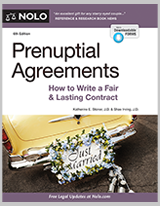
Living together out of wedlock can mean anything, especially in court -- unlike married couples, most unmarried couples don't automatically inherit or receive protection under the law. Consequently, you must document everything from property ownership and children to wills and other estate plans.
An essential resource for any unmarried couple, Living Together explains:
Living Together includes:
The 14th edition provides the latest law in readable 50-state charts, and includes many fill-in-the-blank legal forms. It also discusses the laws covering same-sex marriages and civil unions, which are often so broad, they affect unmarried heterosexual couples as well.
Living together has never been more popular. According to the 2000 Census data, over 5.4 million unmarried couples live together (which translates into 10.8 million people). This is a whopping 72% increase since 1990. Forty percent of unmarried households have children. The number of cohabiting seniors tripled in that same period and is continuing to rise. The average American spends the majority of his or her life unmarried.
If you are part of an unmarried couple living together, it’s probably comforting to know that you are far from alone. However, this doesn’t mean that you can ignore how the law affects your relationship. This book explains the wide range of legal and practical rules that affect opposite-sex unmarried couples living together—from sharing money and property (contract law) to owning a house together (real estate law) or sharing an apartment (landlord-tenant law) to having a child with your partner (family law) to writing a will (estate planning).
Resource: If you are part of a gay or lesbian couple living together, see A Legal Guide for Lesbian & Gay Couples, by Denis Clifford, Frederick Hertz, and Emily Doskow, also published by Nolo.
When you understand the law, you and your partner can make informed decisions about how to structure your life, finances, property ownership, and family relationships to best meet your needs. Failing to learn about the law and take measures to protect yourself and your partner can have negative consequences. The special rules governing married couples (such as those relating to property ownership, divorce, and inheritance rights, to name a few) don’t apply to unmarried couples. In order to compensate for this, you’ll have to do some extra work. For example, you may want to write a will to ensure that your partner gets your property when you die, sign paternity statements to ensure that a father’s parental rights are preserved, or create a “living together contract” to avoid protracted court battles over property if you split up.
To help you, we provide dozens of written documents (both as tear-out forms and on CD) that unmarried couples can use to spell out their individual legal and financial arrangements, including:
We believe that most unmarried couples can safely and easily master the majority of legal rules that affect them. However, it’s also true that an experienced lawyer’s advice can be invaluable when it comes to dealing with more complicated situations. We’ll point out how and when a lawyer’s expertise can be helpful—for example, if one of you has children or substantial assets, or you’re dealing with complicated estate planning.
There are many reasons why people choose to live together without getting married. Some don’t see the need for the state’s approval of their commitment to each other. Many couples view it as a trial period before marriage. Some avoid marriage because they have gone through a messy divorce. Young people in expensive urban areas often live with partners in order to reduce housing costs. A growing minority choose not to marry because they don’t wish to participate in an institution that excludes same-sex couples. And the fast-increasing number of unmarried couples over 45 that live together—over one-fifth of all unmarried couples fall into this category—often have financial concerns that come into play. For example, by not marrying they don’t become legally obligated for their partner’s medical treatment, and they reduce the risk of paying tax on Social Security benefits. And by not marrying, many avoid tricky inheritance issues if one or both partners have children from a previous marriage or own substantial assets.
One of the most common reasons older couples choose to live together instead of marrying is to avoid joint liability for debts, especially for long-term care or medical bills. Staying unmarried also enables each partner to qualify individually for public benefits, such as Medicaid, without draining the other partner’s resources. There are detailed rules about how this must be structured to avoid inadvertent triggering of joint liability, so if you are considering such a strategy, consult with an attorney specializing in elder law before you make any big decisions.
Finally, changing social attitudes and values have made living together less of a stigma; living together is not considered as rare (or immoral) as it was 25 or more years ago. In fact, the American Law Institute, an influential organization of lawyers, judges, and legal scholars, recently recommended sweeping changes in family law, including recommending that family courts and state lawmakers begin to treat living together relationships more like marriage—even recommending that laws provide for alimony-like payments when unmarried couples split up after a long time together.
Whatever your reasons for not marrying, this book arms you with information to tackle most of the legal issues that arise during unmarried partnerships, including better managing your financial affairs, protecting your property, buying a house or other property together, having or co-parenting children, planning for your death, and dealing with a breakup.
Here are summaries of important legal or procedural changes that affect the latest edition of this product.
What's New in the 14th Edition of Living Together: A Legal GuideOverview of What's New
The 14th edition of Living Together: A Legal Guide has new information on seniors living together and an expanded section on homebuying.
Who Needs the New Edition?
You need the new edition if you are interested in the additional information on homebuying or seniors living together.
Chapters Most Affected
Chapters 2 and 6.
Forms That Have Changed
None.
Estate and Annual Gift Tax Exemptions Raised