2010 Robert Bruss Real Estate Book Award
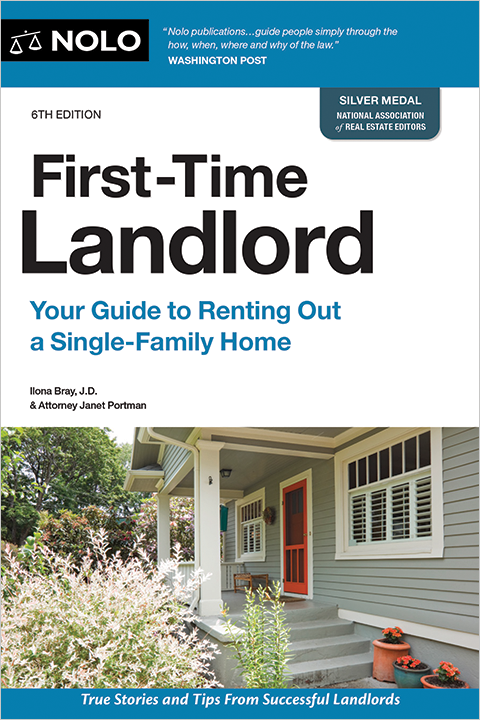
First-Time Landlord
Your Guide to Renting Out a Single-Family Home
- Product Details
- Learn your legal obligations.
- Estimate costs and profits.
- Choose good tenants and avoid problem ones.
- Make the most of valuable tax deductions.
- Handle repairs and property management tasks.
- About the Author
- Table of Contents
- Great Things About Being a Landlord
- Tough Parts of Being a Landlord
- Location, Price, and More: Features of the Ideal Rental Property
- Thinking About Buying an Investment Property?
- Buying a Foreclosed Property
- What Will Your Monthly Profit Be?
- What Will Your Long-Term Gain Be?
- Setting Your Goals
- Pros and Cons of Co-Owning Rental Property
- Having a Compatible Co-Owner
- How to Take Title to the Property
- Creating a Co-Ownership Agreement
- Making Sure Everything Is Up to Code
- Should You Make Major Repairs or Improvements?
- Preparing the Rental for Showing
- Setting the Rent and Other Important Terms
- Getting to Know the Neighbors
- Come on Down! Advertising Your House for Rent
- How to Show Your Property
- Pardon Those People: Renting Property That’s Still Occupied
- Creating a Rental Application
- Checking References and Running a Credit Report
- Avoiding Illegal Discrimination
- Is This the One? Characteristics of the Perfect Tenant
- Whom to Reject
- Which Is Better, a Lease or a Rental Agreement?
- State Laws to Know When Preparing a Lease or Rental Agreement
- Typical Provisions in Leases and Rental Agreements
- Signing a Lease or Rental Agreement
- Getting the Tenant Moved In
- Organizing Your Rental Records
- Keeping Your Business Finances Separate
- Shielding Yourself From Liability for Business Debts
- Spent a Lot of Money? Take More Tax Deductions!
- Proving What You’ve Spent: Record Keeping
- Are You Rich Yet? Tracking Income and Expenses
- How Much Cash to Keep in Reserve
- What to Do When Expenses Exceed Income
- Finding Professionals to Help You
- Dealing With the Legalities: Your Repair and Maintenance Obligations
- Adopting a Good Maintenance and Repair System
- No Thanks! Hiring Someone Else to Do the Work
- Ouch, That Smarts: Liability for Tenant Injuries
- Liability for Environmental Health Hazards
- Keeping Tenants Safe: Liability for Crime
- Insurance Coverage for Property and Liability
- Common Tenant Problems—And What to Do About Them
- Resolving Disputes
- When All Else Fails: Terminations and Evictions
- What a Professional Property Manager Does
- Should You Hire a Property Manager?
- How to Find the Best Property Manager
- Put It in Writing: Drafting an Agreement With Your Property Manager
- What’s the Driving Force? Exit Plan Objectives
- What Are Your Options? Exploring Opportunities
- What Rights Does the Tenant Have If You Sell?
- If You Decide to Sell: Getting Ready
- Advantages and Disadvantages of Rent-to-Own Arrangements
- Setting the Option Price
- Setting the Sale Price of the House
- Specifying a Time by When the Tenant Must Exercise the Option
- Considering Whether to Include Seller Financing
- How Will the Tenant Notify You About Exercising the Option?
- Deciding Whether to Credit Tenants for Improvements
- Alternative to Option Contract: Right of Refusal and Right of Offer
- Get Legal Advice
- Is Renting a Room to a Lodger for You?
- Basic Steps to Renting Out a Room
- Sample Chapter
- Size. The ideal size depends on the local population. For example, a house with several bedrooms will attract more potential renters in an area with lots of families.
- Location. Nearby transportation access—particularly public transport when gas prices are running high—is a big plus. So is proximity to shopping and commercial areas.
- Security. Safe neighborhoods appeal to all tenants. No one likes to live in a high-crime area.
- Good nearby public schools. A family that wants to make sure their children go to the best schools and finds a good home nearby to rent might settle there for years. But even short-term renters appreciate a good school and the corresponding community
- Affordability. With rare exceptions, it’s difficult to find tenants for large luxury houses. Any prospective tenant who has the money to afford the monthly rent can probably also afford to buy a house.
- Condition. Even if it’s otherwise in good shape, a house with ongoing maintenance issues—perhaps having a nearby creek that often floods or being so old that everything is falling apart—might put off tenants who don’t want to be dealing with inconveniences or calling you with numerous repair requests.
- Layout. Like everyone, tenants want a place that’s well designed. Don’t assume, for example, that a renter will be content with a tiny kitchen. And if the house is likely to be shared among roommates, each bedroom should be reasonably private and have bathroom access that doesn’t involve invading someone else’s room.
- Charm and aesthetics. Like home buyers, renters will be drawn to a place that looks But you can’t know every prospective tenant’s taste. That’s why a house with broad appeal rather than quirky features is your best bet.
- Requires little fixing up and For example, a house that’s relatively new isn’t likely to need new plumbing or wiring anytime soon. But this doesn’t mean a newly built house is necessarily the best. A place that’s well constructed but isn’t on the verge of becoming “historic” is your best bet.
- Is close to your own home or work. Who wants to drive for an hour—or get on an airplane—to interview new tenants or to deal with a maintenance problem? And even if you hire a property management company, it’s good to be able to check on the property yourself from time to time.
- Isn’t in a heavily regulated city or area. If your property is in an area with rent control or other restrictions on landlords, take a careful look before you leap. Read the regulations and talk to other local landlords about their If you’ll be buying a property with existing long-term tenants who show signs of planning to stay there forever, you’ll have to make do with below-market rent well into the future. In situations like this, your investment might be a losing proposition.
- Will attract long-term renters. For example, a house near a vacation resort or a college might not be optimal if you’re hoping for year-round tenants. (Students tend to leave at the summer break and switch housing every year, which means regular turn- over and repairs.) If there’s high turnover, you’ll at least want correspondingly low vacancy rates and high rents.
- Doesn’t require evicting long-term tenants. See “Evaluating Resident Tenants” in the discussion of buying foreclosed property,
- Is convenient to commercial supply sources and repair people. Avoid houses in remote locations where you’ll have to struggle to get to a hardware store or find high-quality help maintaining or improving the property.
- Is in a strong rental market. Ideally, you’re looking for a property that’s cheaper to buy than to rent, so you can bring in income. But you’re also looking for a market with lots of would-be renters; otherwise, you’ll find profits eaten up by vacancy periods.
- Less maintenance responsibility. The homeowners’ association (HOA) will take care of common areas, freeing you from hands- on responsibilities like tending the garden or (in most cases) repairing the roof. (Of course, you pay to get these things done via your HOA dues.)
- Affordability. A condo or townhouse is usually cheaper to buy than a single family home, because you own less—you own your particular unit, and you own common areas jointly. And the maintenance can be less expensive too, because costs that might otherwise be individually paid—like landscaping and insurance—are instead shared.
- Amenities to attract tenants. Without having to buy a whole apartment building, you might be able to offer your tenants access to a pool or other recreational or meeting spaces.
- Community rules and regulations. In a CID, residents typically must agree to live by a set of These might govern everything from the size of residents’ dogs to whether they can hang clothes outside, smoke in the unit, change the color of the curtains, or change the color of the outside paint. Getting your tenants to read and abide by these rules when they don’t have a long-term stake in the community can be challenging.
- Restrictions on renting. Possibly the most significant rule in a CID is a restriction on renting. Some CIDs place limits on how many units can be rented or how long a unit can be Some even ban renting altogether. Although the association is unlikely to weigh in on your choice of tenants (which would expose it to liability for discrimination and the like), it might insist that you put certain clauses in your lease (for example, committing the tenant to abide by community rules) or exert other oversight.
- Community fees and Every CID charges regular (usually monthly) dues for maintenance and shared costs, and the rules typically also allow special assessments for major expenses like a new roof on the property or dealing with a flood or another emergency. These fees can run into the hundreds, even thousands, of dollars per month, which you’ll need to figure into your budget. (The landlord is normally responsible for making these payments, not the tenant.)
- Slow property appreciation. Historically, condos and townhomes have appreciated in value at a slower rate than single-family
- Nolo’s Essential Guide to Buying Your First Home, by Ilona Bray and Ann O’Connell.
- The Real Estate & Rental Property section of Nolo.com, which includes hundreds of useful articles on buying, owning, and selling real estate, including investment property.
- Going without the usual buyer protections. As we’ll explain further, below, at most stages in the foreclosure process you’ll forgo at least some of the normal protections available in a typical transaction. For example, you might not get to see the property before you buy, have to accept it “as is,” and have to go without title insurance.
- Waiting to make sure the owner’s rights are All states have laws to make sure banks can’t rip properties out from under late-paying owners on a moment’s notice. For buyers, that means deadlines, delays, court rules, and uncertainty—particularly in the many states that allow the former owner to “redeem” or buy back the property within a certain period of time after it was sold in foreclosure (usually from 10 days to 1 year). Of course, if the owners redeem the property, you’ll get your money refunded. But do you really want to be held in limbo, unsure of whether you’ll ever be able to occupy the house?
- Competition from experienced real estate If there are good deals to be had, you can bet seasoned real estate investors will be lined up in front of you, with cash at the ready.
- Risks of undisclosed repair needs, tax liens, or other issues with the property. Remember, these homeowners were probably financially stressed for a while. They might have held back on maintenance, gotten behind on their taxes, or used the house as collateral for other debts.
- Zillow.com (under “Buy” you can filter for foreclosure properties)
- PropertyShark.com (you’ll need to register for some information)
- RealtyTrac.com (includes state-by-state statistics), and
- Foreclosure.com.
- a copy of the lease or rental agreement
- details on security deposits (location, amount, and whether the old owner will be returning them to tenants, in which case you’ll need to recollect them)
- service contracts (such as for gardening—these can be canceled, but you might not want to if the seller is getting a good bargain)
- utility bills and maintenance and repair records for at least the last year (preferably longer), and
- all other paperwork relevant to the
Do you own a house you’d like to rent out rather than sell? It’s a common scenario in today’s market, especially if you’ve inherited a house, are moving to another home, or are buying an investment property. And the logical next step might be for you to become a first-time landlord. Follow the advice in this book to ease into your new role and earn substantial profits while avoiding costly mistakes.
The 6th edition is updated to cover new trends in tenant-screening restrictions and municipal licensing requirements and fees.
“Nolo publications…guide people simply through the how, when, where and why of the law.”—Washington Post
“Virtually every book from Nolo Press can be highly recommended without reservation.”—Robert Bruss, Nationally Syndicated Real Estate Columnist
Your First-Time Landlord’s Companion
1. Will Landlording Bring You Money and Happiness?
2. So Happy Together: Landlording With Family or Friends
3. Preparing and Marketing Your Rental Property
4. Screening and Choosing Good Tenants
5. Preparing a Lease and Getting the Tenant Moved In
6. Managing Your Rental Income to Maximize Tax Deductions
7. Keeping Things Shipshape: Repairs and Maintenance
8. Landlord Liability for Injuries, Crimes, and More
9. Living in Perfect Harmony? Dealing With Difficult Tenants
10. Don’t Want to Do It Alone? Hiring a Property Manager
11. Ready to Quit? Exiting the Rental Property Business
12. A Slower Exit: Rent-to-Own Arrangements
13. Renting Out a Room in Your Home
Index
Will Landlording Bring You Money and Happiness?
Being a landlord might sound appealing in theory—you find a decent tenant, collect a monthly rent check, and celebrate your good fortune. If only it were that simple.
Before you start fantasizing about a multiunit building on Park Place, let’s look at what it takes to own and manage rental property, and how to decide whether a particular property is actually going to make you money. Along the way, we’ll share some helpful advice from other first-time landlords.
Great Things About Being a Landlord
Owning rental property offers both financial and lifestyle benefits. As Laura, a landlord with properties in Washington, Nevada, and Florida, says, “I like people and the feeling that I’m doing a good job. In fact, I have to be careful not to get too friendly—I have tenants in Florida with adorable kids, and I’m often tempted to volunteer to babysit, but have to remind myself to keep it all business. Of course, it’s also nice to earn money through my efforts and to be able to take tax-deductible trips. I remember the first time I sold one of my rental properties and made a nice profit on the sale; it made me very happy.”
Below is an overview of the various benefits that Laura and other landlords enjoy. Try to remember these later, when you’re cursing the latest plumbing problem or fretting over how to fill a vacancy.
Appreciation and Wealth Building
If you hold onto your property long enough, it will almost certainly go up (“appreciate”) in value—eventually. Since World War II, real estate prices in America have risen an average of around 5% a year (with some nerve-wracking ups and downs in between). And even if the house’s value isn’t rising, renting it might allow you to build equity until you own it outright. Owning investment property is a great way to increase your net worth.
Income
A well-managed investment property, with tenants who pay the rent on time and monthly expenses that are less than the rent, can bring you a steady stream of income. Most landlords who chose to buy single-family homes did so with this purpose in mind.
Diversification of Income
You never know what life is going to throw at you. If you’re laid off from your job or your health takes a turn for the worse, your primary source of income—presumably your salary—could be jeopardized. Owning an investment property diversifies your income stream and can give you somewhat of a cushion.
Low-Risk Investment
Unlike more volatile investments, the returns on real estate are fairly steady. While stock values can fall or even disintegrate entirely, land and property won’t disappear on you. And history shows us that land and property almost always hold their value—or at least bounce back after a tumble. Also, even when property values are down, people need places to live—a fact that keeps rents relatively high even during recessionary periods.
Investment Diversification
Owning property also diversifies your investment portfolio, which is a cardinal rule of investing. The reasoning for the rule is pretty easy to understand, if you get the idea of not putting all your eggs in one basket: Should something unforeseeable happen to your riskier investments, such as stocks, you’ll have the backup of a tangible, relatively low-risk asset. As you approach retirement, it’s good to start shifting into lower-risk investments, to ensure the cash you need doesn’t disappear when you’re relying on it.
Leverage
Unlike other investments, a little bit of cash will buy a lot of real estate: A down payment of 20%—or in some cases, as low as 10% of the value of the property—is usually enough to get you started. You could, for example, buy a $400,000 property with a $40,000 down payment, while that same amount will buy you only $40,000 worth of stock. And if the value of that stock were to increase by 10%, you’d have a $4,000 profit, whereas if the value of the property increased 10%, you’d have a $40,000 profit. (These are, of course, rough figures, in that they do not account for sales commissions, depreciation, capital gains taxes, and so forth.)
This is called being highly “leveraged”—in one sense, deeply in debt, but in another sense, poised to gain high returns based on a relatively small up-front investment. Leveraging your investment allows you to trade up to more profitable properties.
Short-Term Tax Advantages
While the rental income from your property is taxable, you can deduct many of the expenses related to owning and maintaining the property. Among these are mortgage interest (within limits), insurance, repairs, and upkeep. They also include your business expenses, such as your phone, office supplies, and professional fees (for example, to the accountant who helps you figure out your business taxes).
Another major tax advantage is the ability to “depreciate” your property—to take an annual deduction that reflects the decreased value of the property caused by wear and tear. (In the most literal sense, depreciation could turn out to be a fiction if the value of the property goes up a lot—but it can be a wonderful fiction for tax purposes.) Chapter 6 of this book discusses tax issues in detail.
Long-Term Tax Advantages
Even if your property skyrockets in value on paper, the IRS won’t expect you to pay taxes on that increased value until you sell. (Your state and local property taxes, however, probably will rise steadily to catch up with the property’s value.) Unfortunately, when you do sell, you might lose the advantage of the capital gains tax exclusion ($250,000 per owner), if you haven’t lived in the place for two out of the previous five years. However, there are several strategies you can use to decrease your tax liability. We’ll discuss those in Chapter 11.
Part-Time Commitment
If you own just one property and it’s not too far from where you live, you can probably handle its management in your spare time, while still working a full-time job. A little job flexibility will help, of course. Although weeks might go by when the property needs little or no attention, there will be times when it will need hours from you, for example, when you’re getting the place painted while dealing with the departure of the old tenant and interviewing prospective new tenants.
Your time commitment will be even less if you hire a property management company—though your profits will decrease as well. We discuss the pros and cons of hiring property managers in Chapter 10.
Professional Development
Being a landlord and owning property can give you a sense of accomplishment (and some stories to tell at parties). It shows that you’ve broken out of the mold of the average working stiff and are willing to take risks and accept major responsibilities. You’re learning new skills involving finances, human relationships, and maybe even home repair, which can help you in other areas of life.
Personal Satisfaction
Being a competent and conscientious landlord will pay dividends in other respects, too—you’re going to feel pleased about the way you’re doing business. As Amy, who lives in Berkeley, California, and rents out her former home in Austin, Texas, puts it: “I’ve rented from a few crummy landlords myself, so it’s very satisfying to be able to give my tenants a positive experience, for example, by quickly taking care of repairs if something goes wrong.”
Tough Parts of Being a Landlord
Landlording is not for everybody, and not every property is worth keeping or buying as an investment. The main reasons that people tend to give up on landlording are the time required to manage a property effectively, the risks involved (such as problem tenants, long vacancies, and legal issues), and the cost. Here’s a quick overview of these issues. Later chapters in this book provide detailed advice on minimizing and dealing with problems.
Time
Even though landlording isn’t a full-time job, it will take more than an hour or two of your time every few weeks. For one thing, you’ll need to be reachable and available nearly around the clock, to respond to calls from tenants when the plumbing backs up or the neighbor’s dog is barking all night. Occasion- ally, you’ll need to put in large chunks of time, for tasks like listing and showing the property during a vacancy, screening and approving tenants, and handling rent checks and deposits, to name a few.
In this book, we’ll help you strategize ways to cut down on the time you spend landlording. For example, Chapters 3 and 4 will give you tips on how to market your property, attract and choose the right tenants (who will hopefully stick around for awhile), and list the property so as to fill vacancies quickly and efficiently.
Problem Tenants
One of the pitfalls of owning rental property is the possibility that you’re going to get that rare “tenant from hell”: someone who doesn’t pay the rent on time, trashes the property, or constantly bugs you about every little thing that goes wrong—all of which can be expensive to remedy. Catherine, who rents out a cottage behind her house in Berkeley, describes often feeling “vulnerable” because someone else has day-to-day control of property she owns and cares about.
It’s more likely that your tenants will be perfectly decent, responsible people. Good screening procedures (as described in Chapter 4) will help ensure this. Nevertheless, people can change. Catherine’s low point as a landlord came, she says, when “one of my tenants, who six months before had a nice job and drove a BMW, developed a crack addiction. The neighbors formed a watch group around my house, and I’d see drug deals going on and find vials in the backyard.”
A properly structured lease or rental agreement (as covered in Chapter 5) will help deal with difficult situations like this and reduce many of the risks associated with problem tenants. And knowing how to deal with bad tenants (Chapter 9) will also help you do damage control when needed.
| Landlording Duties |
|---|
|
• Research and set rental price. • Establish a bookkeeping system for tracking income and expenses. • Participate in a local landlords’ association (optional). • Learn the key laws and ordinances that cover renting residential property in your state and city. • Advertise property for rent. • Respond to people interested in renting the property. • Clean property and make any necessary repairs in preparation for tenants. • Show property to prospective tenants. • Review tenant applications, obtain credit reports, and conduct reference checks. • Draft and negotiate lease or rental agreement. • Supervise tenant move-in. • Collect and manage security deposit. • Respond to tenant problems or inquiries. • Collect rent. • Respond to late rent and other violations of the rental agreement. • Pay mortgage, utilities, insurance, etc. • Prepare regular tax paperwork. • Evaluate and fix problems and contact maintenance repair people. • Supervise tenant move-out. • Evaluate the condition of the vacated rental and return tenant security deposit. • Handle disputes among tenants (multifamily rentals) or disputes or complaints from neighbors. |
Difficulty Renting
There might be times when the market is soft and it will be difficult to rent your place out. Vacancies are a reality of life for most landlords, but can be made worse by local economic conditions, the need for major repairs in your property, or just sheer bad luck. That’s why we’ll make sure you factor vacancies into your analysis of potential profits on the property.
Legal Risks
If you really want to talk worst-case scenarios, you could worry about the legal risks that come with owning rental property—that is, the possibility that a tenant, prospective tenant, or someone else on your property will sue you over a health, safety, environmental, discrimination, or other legal matter. You could even face legal trouble from third parties, stemming from misbehavior of your tenant. For example, if a tenant’s drug dealing results in injury to a neighbor, you might be liable if the neighbor can prove that you knew what was going on but failed to take action.
Knowing your own responsibilities and potential liabilities (which we’ll describe in Chapter 8) and acting to reduce the risk of problems occurring will limit the chances that you’ll face serious legal situations.
Costs
The costs of owning an investment property go well beyond the mortgage. They include property taxes, insurance, utilities, upkeep, repairs, property management costs (if you choose), wages for a handyperson, legal costs when needed, and much more. All in all, operating a property as a rental is probably more expensive than using it as your primary residence.
As Dennis, who’s been a landlord for decades, describes it, “We haven’t had much of a negative cash flow on our properties, but we have sometimes. From a financial point of view, if people are really tight, they shouldn’t get into the landlord business. There’s always the unexpected plumbing problem or an appliance that wears out.”
Reducing costs is one of the keys to being a successful landlord. We’ll advise you on how to assess the cost side of your property in Chapter 6.
Licensing
Many cities require landlords to get a license to rent out their property. Aside from the added expense of obtaining a license (typically ranging from $100 to $300 annually), licensing programs often require rental properties to meet minimum standards and pass an inspection. Some cities’ standards go well beyond basic habitability. For instance, Boulder, Colorado, has a four-page checklist of criteria rentals must meet, including potentially expensive upgrades such as meeting the city’s strict energy efficiency requirements (think all new windows for many homes), having a foundation free of cracks or breaks, and even ensuring that every bedroom has access to a bathroom on the same floor (lacking in many older houses). Before you commit to renting your property, fully investigate whether your city requires a license for your rental—and what it will take to get that license.
The Unexpected
Situations you never anticipated can throw a wrench into your well-laid landlord plans. Take, for example, the hardships faced by landlords during the COVID-19 pandemic. Landlords faced laws of varying severity restricting their ability to evict nonpaying tenants, as well as challenges in showing property in person. Another example is the unexpected adoption of rent control laws in many areas.
Location, Price, and More:
Features of the Ideal Rental Property
Whether you’re planning to buy a rental property or deciding whether to keep a property you already own, one of your first considerations should be whether the place is actually suited for renting. Look especially hard at features of the property that can’t be changed, like its location and whether it has a yard. Consider its suitability from both the tenant’s vantage point and yours.
What Gives a Property “Tenant Appeal”?
Here are the characteristics of a rental that tenants tend to care most about:
Of course, tenants will also be concerned with certain nonphysical parts of the property, like how much rent you charge and whether you allow pets. However, such policies are largely within your control and don’t affect whether you’ll buy or keep the house in the first place, so we’ll discuss them in Chapter 3.
What Makes a Good Rental From the Landlord’s Point of View?
After thinking about whether your property has sufficient tenant appeal, turn your attention to whether the house you’re considering is appropriate for you, given your available time, skills, and interest. In most cases, an ideal rental property:
CAUTION
Dealing with maintenance gets a lot harder at a distance. As Kyung, who formerly rented out her triplex home in New Haven, Connecticut, explains, “For the 10 years we lived in the unit above the rental, we had practically no maintenance problems. But wouldn’t you know it, as soon as we moved to Pennsylvania, things started to fail. The tenants were calling in the middle of the night, and I’d have to call some 24-hour service and pay a premium to get the repairs made.”
Special Concerns When Renting Out a Condo or Co-Op
Whether you already own a condominium or another home in a common-interest development (CID) or are thinking of buying one, you need to be aware of how the property’s unique features impact its suitability as a rental property. (In some regions of the U.S., CIDs are referred to as “common interest communities” or “CICs.”)
Condos and townhomes are the most common types of homes in CIDs. Renting them offers special advantages, including:
But let’s not forget the disadvantages:
We’ve given a broad description of CIDs, which can vary immensely in physical features and character. Your job, before deciding to buy or rent out one of these properties, will be to fully research its costs, rules (often in a document called covenants, conditions, and restrictions, or CC&Rs), and current community concerns. Read the CC&Rs and recent meeting minutes thoroughly, talk to neighbors, and investigate the reputation and financial strength of the property’s builder and manager.
Is Airbnb or VRBO for You?
Many people who own rental property in popular tourist destinations or college towns choose to rent their homes through Airbnb or another short-term hosting or rental service.
This book focuses on more traditional rental situations, where you sign a fixed-term lease or a month-to-month rental agreement with one or more tenants. You will have screened these longer-term tenants by running a credit report and checking references.
Renting through Airbnb or a similar service involves a separate set of legal and practical issues concerning taxes, insurance coverage, local registration, liability for guest injuries, and so forth. Having different people come in and out of your rental house can cause major headaches for neighbors and might even violate the law.
Many municipalities, including large cities such as New York City, San Francisco, and New Orleans, have legal restrictions (often quite severe) on short- term home rentals. Local registration or licensing requirements, tax rules, and other policies vary greatly from place to place, so check yours if you’re even thinking about renting your home for short stays. The Responsible Hosting section of Airbnb.com has a summary of the legal requirements of more than 50 cities, with links for details. If your city isn’t listed on the Airbnb site, call your city’s zoning board or local housing authority for information, or do your own research on local law at www.statelocalgov.net or Municode.com. Another useful resource is the Short Term Rental Advocacy Center (www.stradvocacy.org), created by Airbnb, HomeAway, TripAdvisor, and FlipKey.
If you own a condo, co-op, or other property in a planned development, ask your homeowners’ association or co-op board about its short-term rental policies.
While you might end up bringing in more money each month by renting your house through VRBO or a similar service, carefully consider all the relevant issues, including how much time you’ll need to spend screening guests or arranging for cleaning in between visitors. To get further informed, see the Short-Term Rentals of Your Home area in the Homeowners section of the Real Estate & Rental Property section of Nolo.com. You’ll find articles on insurance, taxes, renter screening, legal restrictions, and neighbor concerns. Also, to prevent your tenants from renting a room or space within their rental via a short-term rental service, make sure your lease or rental agreement prohibits sublets, as recommended in Chapter 5.
Is Sharing Your Home With a Lodger for You?
Some homeowners decide (for either financial or social reasons) to stay in their homes and rent out a room in their house to a lodger. Because this is different than the typical landlord-tenant relationship, we’ve devoted a special chapter to the subject. See Chapter 13 for details.
Thinking About Buying an Investment Property?
Not all landlords are accidental landlords. You might be thinking about buying a property so that you can rent it out. (If not, and you already own a property, skip down to the section below, “What Will Your Monthly Profit Be?”)
Before you make that decision, you’ll want to do a careful analysis of the costs and potential returns of your investment. Keep in mind that real estate is not a get-rich-quick business. You’ll have to invest some significant cash up front. And while your rental income might be a source of ongoing profit (we’ll help you calculate how much below), a large portion of the financial gain will come about as time passes and the value of the property increases. And you won’t actually realize that benefit until you sell (though you could use your increased equity as collateral for a loan).
While some people have gotten rich in real estate, you’ve probably seen the headlines about the many who’ve been disappointed—the would-be house “flippers” who, during a real estate downturn, found they couldn’t buy and sell property for quick profits as they’d planned, and ended up in foreclosure or bankruptcy. For many of them, turning their houses into rental property wasn’t an option—their carrying costs were too high compared to the rents they could charge, and they faced a long road of losses ahead.
We’re going to assume you don’t have aspirations toward house flipping, but are looking to invest in rental property over the long term, and ride out the inevitable ups and downs of the market. Or perhaps your ultimate goal isn’t to sell, but to live in the home yourself, after you’ve retired. Let’s evaluate your budget and how buying a rental property will fit in, as both a short-term and a long-term investment.
RESOURCE
This book doesn’t attempt to present a complete guide to choosing a house to buy or financing investment property. Some good resources for that include:
How Much Cash You Can Put Down
To determine whether buying an investment property is even a financial possibility for you, let’s start with a simple calculation: How much cash can you free up for a down payment, and how much house will that buy? Most lenders require 20% down, especially on an investment property. A quick visit to the real estate section of your local paper or to an online site like www.realtor.com will show you typical prices in the location where you’re interested in buying.
You’ll also need to budget around 2%–3% of the house’s price for closing costs, depending on what state you live in, what kind of mortgage you get, and what you can expect to pay in escrow fees, title fees, real estate agent commissions, and taxes and insurance at closing. So if you can put down $80,000 plus pay $12,000 in closing costs, you’re well on your way to buying a $400,000 property. If your cash on hand will likely buy a worthwhile rental in your area, keep reading.
CAUTION
Looking at a fixer-upper? In that case, you’ll need even more cash on hand. Major home improvements always seem to take more time and money than originally expected, so think twice about this strategy if you’re not experienced with home repairs or construction.
How Large a Loan You’ll Qualify For
If you’ll be taking out a loan with which to buy your property, you’ll need to show a lender that you can afford the monthly payments. One of the tests that lenders use is your credit history and score, or your record of paying debts on time. We’re not going to discuss credit scores in detail here—for more information, see the free articles in the Debt Management section of Nolo.com.
The other test that lenders use is the comparison between your income and your debt load, called your “debt-to-income” ratio. The more debt obligations you have, the less likely the lender is to let you take on more. In fact, the lender might be stricter than when you bought your first home, because lending practices have tightened and mortgages on investment properties are considered riskier.
CAUTION
Evaluate your monthly expenses even more strictly than your lender does. What we’re discussing here is how much mortgage you’ll qualify for. But if you tend to spend everything you earn each month— and perhaps aren’t even sure where the money is going—you need to get your first house in order before taking on a second one.
The concept of “debt-to-income ratio” isn’t as complicated as it sounds. The lender looks first at your household’s gross monthly income (the amount you earn before taxes and other monthly withdrawals, plus income from all other sources, like rents, royalties, alimony, or investments). Then it makes sure that your combined minimum debt payments on the property—the ones going toward your PITI (principal, interest, taxes, and insurance), plus any community association fees, credit card payments, car debt, student loans, and more—don’t eat up more than a certain percentage of that gross income. See the “Sample Debt-to- Income Front-End Ratio Worksheet,” below.
How high can your debt-to-income ratio go? Traditionally, lenders require that PITI payments not exceed 28% of the borrower’s gross monthly income (sometimes called the “front-end ratio”), while overall debt shouldn’t exceed 36% (the “back-end ratio”). Federal guidelines also say that a home borrower’s total debt-to-income ratio for a “qualified mortgage” should not exceed 43%.
With such ratios in hand, the lenders set your maximum monthly mortgage payment. Using the calculators listed below, you can arrive at a roughly equivalent figure—and then decide whether that amount is enough to buy a rental property in your chosen area.
| Sample Debt-to-Income Front-End Ratio Worksheet | ||
|---|---|---|
|
Gross monthly income: |
$4,000 |
|
|
Gross monthly income x .28 |
$1,120 |
= Maximum monthly PITI payment |
|
Gross monthly income x .36 |
$1,440 |
= Maximum monthly debt overall |
RESOURCE
Ready to run some real numbers? Find online affordability, as well as household budget, calculators at Nolo.com/legal-calculators, HSH.com, and Interest.com. Make sure any calculator you use factors in the amount of your down payment, income and debts, and estimated taxes and insurance.
Keep in mind that interest rates are higher on investment properties, so your calculations shouldn’t assume that you’ll qualify for the rock-bottom rate offered to buyers with stellar credit who are buying primary residences. You won’t be offered these rates, because lenders know they’re in a riskier position when their borrower is paying two mortgages: If you hit hard financial times, you’ll pay the mortgage on your primary residence first.
Some investors with lots of equity in their primary residences get around these higher rates by doing a cash-out refinance (drawing out cash from their main home to pay for a second) or taking out a home equity loan. This strategy is beyond the scope of this book; in general, while you can use it to get a lower interest rate, the lender will subject you to the same financial evaluation discussed above.
Fortunately, lenders will allow you to include your expected income from the rental property in your calculations. This will help you qualify for a bigger loan. However, lenders will probably be conservative in estimating your likely income, for example, by figuring a higher-than-expected vacancy rate.
You’ll need to know how much loan you qualify for so you can estimate what kind of property you can buy, how much it will cost you each month, and how much you can expect it to bring in. Later in this chapter, we’ll cover whether it’s profitable to buy based on these factors.
Buying a Foreclosed Property
Although fewer foreclosure properties are available now than in past years, many buyers continue to brave the uncertainties and frustrations associated with such transactions to
buy homes for use as investments.
Foreclosure properties tend to be in rough shape (there’s a reason they’re known as “distressed”), and some come with resident tenants and even recalcitrant former owners. You’ll need to be prepared for the special challenges that come with them.
The main advantage to buying a foreclosure is price—you’re likely to get a good bargain, whether you buy from the owner (preforeclosure), at a foreclosure sale, or directly from the bank (known as “real estate owned,” or REO). The main disadvantages to buying foreclosure properties are:
RESOURCE
To find out your state’s redemption period and get other summaries of your state’s law regarding foreclosures, see the Foreclosure section of Nolo.com.
Still interested in pursuing foreclosed properties? Find an agent who specializes in them—most don’t handle them at all, while some go so far as to arrange bus tours of local foreclosures. A good source is REONetwork.com. If you still have a regular real estate agent, explain to both agents what you’re doing, so that you can agree on each agent’s limited role. You’d also be wise to hire a real estate attorney to help navigate this somewhat touchy area.
RESOURCE
For information on foreclosures, see the following sites:
Investigating the Home’s Maintenance History
If you are buying during preforeclosure, the current owners should (depending on the laws in your state) give you a filled-out disclosure form and answer any questions you might have. (And of course, before closing the deal, you’ll want to have the house inspected.) There’s a good chance that you’re dealing with a home that has already been a rental.
If you don’t have access to the prior owner, ask the neighbors about the house’s maintenance history. Did the owners take pride in their home and leave it in good shape? Or was the home occupied by malicious tenants who were unsupervised by an owner already demoralized by the property’s imminent loss? Or was the home occupied by resident owners who spitefully trashed the home before moving out?
No matter whom you talk to, be prepared for disappointing news. As neighbors, brokers, banks, and eventual new owners of distressed properties have learned all too well, the prospect of losing one’s property—whether owned or rented—spurs some to acts of vengeful destruction. Refurbishing these properties will involve considerable expense.
Even if the property was a rental that escaped the wrath of its last occupants, think about the extent of wear and tear it has undergone. Often, rental properties suffer more deterioration than owner-occupied homes. (In fact, 37.5% of renters admit that if they owned the home, they would treat it better, according to a 2019 Porch.com survey.) Take this into consideration when setting your purchase bid.
Dealing with Former Owners
Occasionally, you’ll find former owners still in residence right through the foreclosure proceedings—and beyond. Some of these folks simply have nowhere to go and figure that they’ll stay on as long as possible. The sight of a new owner might be the last straw that will trigger their departure, but maybe not.
If you inherit former owners, you’ll need to evict them. (Do not resort to self-help measures, which can turn nasty.) But you might not be able to evict using the same methods as you would to evict ordinary tenants. (Under normal circumstances, tenant evictions are very quick compared to other types of civil cases; many states provide simple fill-in-the-blank forms, making it possible to handle the matter on your own.) Instead, evicting a former owner might involve a more complex lawsuit, for which you will probably need a lawyer.
Dealing with Current Tenants
It’s possible that the house you’re considering will come with resident tenants who were renting from the prior owners. For years, most tenants lost their leases when a rental property was foreclosed on, but that’s no longer the case. Now, under federal law, all leases will survive a foreclosure, except when new owners intend to personally occupy the premises (in which case, the current tenant’s lease can be terminated with 90 days’ notice). Month-to-month tenants can be terminated with 90 days’ notice (which is longer or as long as any notice period required by the states). Many states and municipalities have laws providing the same protection.
As a result, if you are buying a home that you intend to use as a rental and it comes with a lease-holding tenant, it’s likely that you’ll have to honor the lease. You can terminate month-to-month tenants with 90 days’ notice, but keep in mind that if the home is subject to state or local rent control laws or other laws requiring landlords to have a “just cause,” or good reason, to terminate a tenant, you cannot give the tenant a notice to vacate the property. You’ll be stuck with these tenants for as long as you use the property for rental purposes or until you fit within one of the allowable reasons for termination.
Evaluating Resident Tenants
If you’re inheriting month-to-month tenants in a non-rent-controlled property, should you allow them to stay? Evaluate these tenants as you would any others. If they’ve been paying rent on time (which, admittedly, might be hard to find out unless you can talk to the prior owner) and have been taking reasonable care of the property, you could decide to keep them and negotiate your own new rental agreement or lease (after giving the tenants 90 days’ notice).
But if you sense trouble, particularly if the property comes with tenants who have lots of time left on a lease, think twice about purchasing the property. You don’t want to be saddled with tenants whom you’d never have rented to in the first place. If you go ahead and purchase the property, while counting on evicting the residents, understand that if these tenants refuse to leave, you’ll need to begin an expensive and drawn-out eviction. This is hardly the way to begin your new rental business.
What Will Your Monthly Profit Be?
Earning steady profits from the rent stream off your investment property should be at the top of your goals list. So don’t just guesstimate or hope for the best. Do the research and run through the analysis below to determine whether you’ll make money each month.
Calculate Rental Income
Wouldn’t it be nice if you could just add up your expenses for the property, tack on a little extra for profit, and call the result your monthly rental amount? Unfortunately, it doesn’t work that way (except by coincidence). The local rental market largely sets the prices, based on how many properties are available and what tenants are willing and able to pay. That’s why many landlords must settle for rents that don’t actually cover their costs, hoping that long-term appreciation in property value will make their investment worthwhile.
As a first-time landlord, your safest bet is to rent out your property only if the rent you can charge will cover your expenses (unless you have no other realistic choice). To figure out whether that’s feasible, look at local ads for comparable properties of the same size and condition, in the same neighborhood and school district. Or check Rentometer.com, which provides median rent amounts by area.
If the house is already being rented, the existing landlord will of course tell you what the monthly rent has been—and will continue to be, if the tenant has a lease that lasts beyond the property transfer. (You can’t raise the rent until you renew the lease.) But if the tenant will be leaving, your outside research will come in handy, because the landlord might have kept the rent below market rates, perhaps in order to keep a good tenant. And even a tenant who wants to stay might have only a month-to-month rental agreement, which you are free to either terminate or renegotiate (unless your state or local laws add restrictions).
For more on rentability, see “What Gives a Property ‘Tenant Appeal’?” above. And see Chapter 3 for ideas on how to spiff up your house for added appeal. When setting your rental policies (which we’ll detail in Chapters 3 and 5), consider whether you might be willing to, say, allow pets or charge a lower security deposit in trade for a higher rent. Depending on who your likely tenants are, a furnished property might also allow you to raise the rent—for example, if you’ll be renting out a downtown condo to busy young professionals. This will be particularly handy if you inherited a fully furnished property.
Also visit other rentals (say, during open houses) to see how yours stacks up. There’s no need to be undercover about it—identify yourself as a new landlord researching the market, and you might find a fellow landlord who’s eager to share tips and stories.
| When Will You Be Able to Raise the Rent? |
|---|
|
After you’re in full swing as landlord, keep an eye on changes in your local rental rates by watching the ads and talking to local real estate management experts. If rents go up, then you might be able to renegotiate a raise at the next lease renewal or, if you have a month-to-month rental agreement, within the next month or two (depending on your state’s requirements for giving the tenant advance notice). State and local rent control laws, if any, will also affect when and by how much you can raise the rent. The next question is whether you’ll want to raise your rent. Dennis (the longtime landlord mentioned earlier) says, “I usually don’t raise the rent on anyone in the property. I raise it when I rent to someone new. Maybe I can save 50 bucks a month by raising the rent, but I can save thousands by not having it vacant. I have one set of tenants whose rent I haven’t raised in 12 years. They’re the nicest, neatest people. They put in their own blinds; they garden and mow.” |
After figuring out a likely market rent, your next task is to check into the local vacancy rate, usually expressed as a percentage. A real estate or property management company should be able to tell you how many rental houses like yours are sitting empty. You can also get a sense of likely demand for your house by considering factors such as whether your area is growing economically (so that new employees need housing), whether there’s a steady stream of likely renters (such as students), and whether home prices are out of reach for the average local resident, who will turn to renting instead. Nationwide, the average annual rental vacancy rate is 5.8%, according to U.S. Census Bureau figures. Of course, this is just a ballpark and varies depending on where your property is located, but you might be able to lower your vacancy rate by using some of the methods in this book to find and keep long-term tenants.
Putting it all together, you should be able to come up with a monthly and an annual dollar figure that your rental is likely to command—the monthly rent figure times twelve, minus expected vacancies. Assume that your vacancy rate will be the same as the average where you live, even if you expect to have a long-term renter.
TIP
Consider setting your rent slightly below market rates. In the experience of Gordon, a landlord with a single-family property in San Jose, California, “It’s important to not charge as much as you can get away with. If you charge top dollar, you’re more likely to have a tenant not take care of it. But if you give them a fair rent and they feel you’re treating them fairly, they’ll return the favor by taking care of the place.”
Subtract Expenses
If you’re already a homeowner, you know that keeping up a home isn’t cheap. Your regular annual expenses will include the mortgage (both principal and interest, assuming it hasn’t already been paid off), homeowners’ insurance, property and other taxes, and property management services if you decide to use them. You’ll also face less predictable expenses, such as maintenance and improvements, accounting fees now that you’re in business, and more.
Now’s the time to draw up a budget, estimating what it will cost to keep your property. The worksheet below will help with this task. We’ve broken it down so that you enter monthly figures—of course, you’ll need to fiddle with some of the numbers, for example dividing your annual property tax payment by 12.
CAUTION
Double the amount you think you’ll spend on maintenance. If you base your likely maintenance figures on what you usually spend on your own home, you’ll probably come out low. Tenants tend to be harder on houses than owners and are blind to minor maintenance issues until they become major. And habitability laws will require you to make some repairs that you might otherwise have delayed.
If the property is already being rented, the departing owner is a valuable source of financial information. Ask for:
And if the current tenant plans to stay, figure out which expenses you can cut out of your budget accordingly. Advertising and screening are the obvious ones, but you might be able to reduce the number of repairs and improvements you otherwise would have done before a new tenant moved in.
TIP
If you want existing tenants to stay, encourage them. During a transfer, tenants might worry that the new landlord will be difficult to work with and will raise the rent or change other lease or rental agreement terms as soon as legally possible. Some will start looking for a new place, just in case. As soon as you can, meet with the tenants to explain your policies and establish some personal rapport.
| Monthly Property Expense Estimate | |
|---|---|
| Expense Description | Amount |
| Advertising and tenant screening | $ |
| Local transportation | $ |
| Out-of-city travel, meals, lodging | $ |
| Cleaning and maintenance | $ |
| Homeowners’ insurance (if not included in mortgage payment) | $ |
| Legal and other professional fees (accountant, property manager) | $ |
| Mortgage payment (principal and interest, plus property taxes and insurance, if included) | $ |
| Other loan payments | $ |
| Repairs | $ |
| Appliances and furnishings (irregular but major expenses, such as a refrigerator) | $ |
| Supplies (for office and rental property) | $ |
| Income tax | $ |
| Property tax (if not included in mortgage payment) | $ |
| Utilities and phone (if not covered by tenant) | $ |
| Gifts and entertainment | $ |
| Licenses | $ |
| Homeowners’ association dues (in condos and some developments) | $ |
| Landlords’ association dues, if you choose to join one | $ |
| Educational publications, subscriptions, and memberships | $ |
| Tools and equipment | $ |
| Construction and improvements | $ |
| Other miscellaneous expenses | $ |
| Total estimated expenses | $ |
Our expense worksheet also includes some categories that you might not be able to estimate yet, such as gifts (for example, flowers to your tax accountant for dealing with your shoebox of receipts). Leave these blank if you can’t imagine paying them—but use them as a reminder of possible unexpected expenses.
CAUTION
Costs can mount if you’re unable to make regular visits to the property. Amy explains, “My property tax bill recently went up significantly, and I decided it wasn’t worth the time and expense to fly from California to Texas to appeal it. But if more surprise costs like this come along, I’ll probably have to either raise the rent or sell.”
Estimate Short-Term Profits
Continuing with the simple calculations, let’s say you can afford to buy—or you already own—a house that’s suitable for renting. Now you need to estimate whether the rent will cover your costs. Do that by filling in the chart below.
| Estimated Monthly House Profit or Loss | |
|---|---|
| Expected rental income (based on “Calculate Rental Income,” above) | $ |
| Estimated costs (based on “Monthly Property Expense Estimate” worksheet, above) | $ |
| Profit or loss (A minus B, or expected income minus estimated costs) | $ |
This chart will tell you whether you stand to make money on such a property in the short term. If the income comes out ahead of the costs, great. But remember that if you’re buying a rental property, you’ll probably make a large down payment and might eventually want to sell the place—so it’s worth figuring out the ultimate return on your investment, which we’ll discuss next.
If the property’s expected income isn’t enough to cover its costs and more, we recommend walking away (if you can—see our discussion for people trying to avoid foreclosure, below). Sure, the place might make a good long-term investment if and when property values rise, but that’s a different ball game—we’re assuming you picked up this book because you wanted to earn regular money as a landlord, not aim for one-time profits.
CAUTION
This calculation doesn’t include tax benefits. These benefits—depreciation and other tax deductions—can reduce your tax liability by thousands of dollars. If your calculations look borderline, skip ahead to Chapter 6, where you’ll learn more about what these tax benefits are and how they help you increase your profits.
Another thing worth considering is the value of your own time. We can’t calculate that for you, but in this book we will discuss some of the tasks that go into being a landlord.
We hope you enjoyed this sample from Chapter 1 of First-Time Landlord: Your Guide to Renting Out a Single-Family Home. The complete book is available for sale here at Nolo.com.
Customers Who Bought This Item Also Bought
$31.49
Your Guide to Renting Out a Single-Family Home
