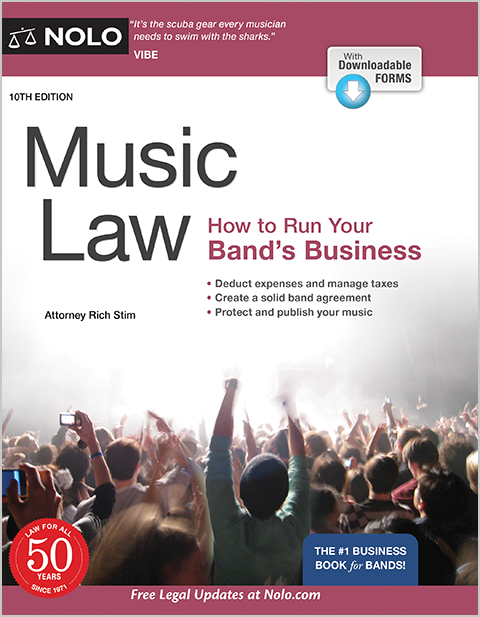
Music Law
How to Run Your Band's Business
- Product Details
- write a partnership agreement
- buy, insure, and maintain equipment
- use samples and do covers register your band’s name
- sell and license your music
- get royalties for streaming and downloads
- deal with taxes and deductions
- find the right manager and write a fair contract
- get gigs and get paid
- protect your copyright legally
- deal with legal issues in the recording studio, and
- negotiate record contracts.
- Band Partnership Agreement
- Management Agreement
- Label-Shopping Agreement
- Performance Agreement
- Tour Budget
- Form CA
- Form PA
- Artwork Agreement
- Model Release Agreement
- Musician Release Agreement
- Agreement With Record Company for Use of Master Recording Sample
- Agreement With Music Publisher for Use of Song Sample
- Blank Recording Budget
- Independent Label Recording Agreement
- Independent Label License Agreement
- Duplication: Manufacturing Your Recordings Notice of Intention to Obtain Compulsory License for Making and Distributing Sound Recordings
- Mechanical License and Authorization for First-Time Recording of Song
- Selling Your CDs, Records and Tapes Consignment Form
- Invoice
- Independent Distribution Agreement
- Taxes Form SS-4
- Simple Master/Sync License
- Sync License
- Master Use License
- About the Author
- Table of Contents
- Taking On the Music Industry
- Your Band Is a Business
- Apathy Is Not the Answer
- Common Band Issues
- Written Agreements: Your First Line of Defense
- Who Needs a Band Partnership Agreement?
- Using a BPA to Avoid Getting Screwed
- Abbreviated Band Partnership Agreement
- Full-Length Band Partnership Agreement
- What’s the Right Business Entity for Your Band?
- Converting From a Partnership to an LLC
- What Is a Manager?
- Avoiding Common Management Problems
- Abbreviated Management Agreement
- Full-Length Management Agreement
- Variations on Management Arrangements
- Entertainment Attorneys
- Locating, Hiring, and Firing an Attorney
- How to Avoid Getting Screwed by Your Attorney
- Having an Attorney Shop Your Music
- Label-Shopping Agreement
- Equipment Ownership
- Buying Band Equipment
- Insurance, Maintenance, and Inventory of Your Equipment
- Preventing and Dealing With Theft
- Getting Gigs and Getting Paid
- Performance Agreement
- Touring
- Sample Tour Budget
- Copyright Basics
- Coauthorship and Co-Ownership of Songs
- Copyright Infringement
- How to Avoid Getting Screwed in Conflicts Over Songs
- Copyright Registration
- Preparing a Copyright Application for a Song
- How Songs Earn Money
- The Music Publishing System
- Dividing Up Song Income Within the Band
- How to Form Your Own Music Publishing Company
- Trademark Basics for Bands
- Researching Band Names
- Dealing With Trademark Disputes
- Registering Your Band Name With the Government
- Legal Issues With Artwork
- Information to Include in Your Artwork
- Getting the Artwork Done
- Abbreviated Artwork Agreement
- Full-Length Artwork Agreement
- Model Release Agreement
- Legal Issues in the Recording Studio
- Musician Release Agreement
- License for Use of Sampled Music From Record Company
- License for Use of Sampled Music From Music Publisher
- Budgeting for Recording
- Sample Recording Budget
- Choosing a Recording Studio
- The Sound Recording Copyright
- Paying for the Right to Duplicate Songs
- Notice of Intention to Obtain Compulsory License
- Mechanical License and Authorization for First-Time Recording of Song
- How Many CD Copies Should Your Band Order?
- How to Avoid Getting Screwed During the Duplication Process
- Streaming Revenue
- Download Revenue
- Offering Downloads
- Getting Non-Music Data Online
- Distributing Vinyl and Compact Discs
- Direct Sales
- Record Agreements: Key Elements
- Independent Record and License Agreements
- Reviewing Royalty Statements
- What Is Music Licensing?
- Simple Master/Sync License
- Sync License
- Master Use License
- Tracking Band Finances
- What Is Cash Flow and Why Is It Essential?
- Using a Credit Card to Finance Your Band
- Categorize Sources of Band Income
- Taxing Situations: Understanding Your Band’s Tax Responsibilities
- Income Taxes: Different Rules for Different Businesses
- Tax Deductions: Secrets for Saving on Taxes
- Payroll Taxes: When Your Band Hires Employees
- How to Get a Federal Tax ID Number (FEIN) for Your Partnership
- Editing RTFs
- List of Forms
- Sample Chapter
- Disputes between band members. Sometimes the only harmony within a band is provided by the backup singers. Sure, confrontations may spark the band creatively, but most of the time, they distract you from making great music. This book includes a simple band agreement that can prevent some disputes over money, ownership of the band name, and ownership of band equipment. We also have suggestions for avoiding disputes in the recording studio, over song ownership, and about division of song income.
- Management issues. A good manager can be an excellent buffer between your band and the business. A bad manager can be a major disaster. Within this book, you will find some common ways that managers screw bands and how to avoid it.
- Lawyers. There are occasions when your band must hire an attorney—for example, to negotiate a major contract, or to sue or to defend your band in a lawsuit. This book provides detailed discussions about when a lawyer might be necessary, suggestions on how to choose the right lawyer, and tips on how to avoid being overbilled.
- Song ownership and music publishing. Ownership and publishing of songs results in substantial music business revenue. For that reason, it is potentially explosive territory for bands and often members can’t seem to agree on who wrote a song or how to split the revenue. You’ll find plenty of information on these issues and some practical alternatives on how bands can divide songwriting income.
- The making and selling of your band’s recordings. Some bands make a comfortable living without ever signing with a label. They perform for years, surviving on the sale of their own recordings. It’s not that hard to master the business of making and selling band recordings. You will find recording tips and methods of distributing and selling your music online and off. In addition, we have included a chapter on licensing your band’s music for use in film, TV, and advertisements.
- Record companies and distribution. Many bands are surprised to find that their troubles really begin once they get signed to a record company. As Kurt Neuman of the BoDeans put it, “We had it made and then we got a record deal.” This book addresses most of the important issues for an independent record deal, and explains the principles of independent distribution.
- Taking your band online. It’s easy to bring your band to a global audience without leaving home. This book explains the issues involved with taking your band online.
- Band names. In this book, you will find plenty of information on trademarks and other band name issues as well as an explanation of how to research and register your band’s name with the federal government.
- Partnership agreement: for all band members; covers how to divide expenses and profits, rights to songs, rights to the band name, and related issues.
- Management agreement: for your band and your manager; covers commissions, length of representation, and post-termination issues.
- Label-shopping agreement: for your band and your attorney (or whoever is shopping your band to record companies); covers issues such as the extent and length of payment for the representation.
- Performance agreement: for your band and the venue that is booking your band; covers the payment and other performance details.
- Model release agreement: for your band and any person whose image is used on band artwork or merchandise; covers the extent of the use and the payment.
- Artwork agreement: for your band and those providing artwork for recordings or merchandise; covers the extent of the artwork use and payment.
- Musician release agreement: for your band and any nonband musician providing a performance for recordings; covers the extent of the musical use and payment.
- Compulsory license agreement: for your band and any nonband songwriter or copyright holder; deals with the right to “cover” that person’s song on your band’s recording.
- Simple Master/Sync License: for basic licensing of music for use in a film or video and when the songs and recordings are owned by the same entity.
- Sync License: for licensing songs for use in films or TV; this can be modified for other sync rights—for example, for use in advertisements.
- Master Use License: for licensing sound recordings for use in films or TV.
- Independent label recording and license agreements: for your band and an independent record label; covers the details of ownership and making of recordings.
- FORMS
Whether you’’re recording an album, budgeting a tour, or livestreaming concerts, you need solid information to make the right legal and business choices.
Music Law is the all-in-one guide you need. Written by musician and lawyer Rich Stim, it explains everything you need to:
This is the most useful business and legal guide for bands and independent musicians. Completely updated to provide the latest in the law and current business practices, it covers music licensing and trends in livestreaming and other new revenue sources.
“It’s the scuba gear every musician needs to swim with the sharks.”—Vibe
“If you’re serious about a career as a performing musician, you’d have to be a damn fool not to rush out and buy a copy of this book.”—Jim Aiken, Keyboarde
Partnership Agreements
Agreements With Managers and Attorneys
Performance and Touring
Copyright Applications
Album Artwork
Recording Agreements
Taxes
*Audio files are not available with the ebook
Your Legal Companion
1. Yes, Your Band Is a Business!
2. Band Partnerships and Beyond
3. Management
4. Attorneys
5. Band Equipment
6. Performance and Touring
7. Copyright and Song Ownership
8. Publishing Your Band’s Music
9. Band Names
10. Artwork
11. Recording
12. Duplication
13. Earning Money From Recordings
14. Independent Record Agreements
15. Licensing Your Band’s Music for Film, TV, and Advertising
16. Keeping Track of Your Band’s Money
17. Taxes
Appendix: Using the Downloadable Forms
Index
Chapter 1
Yes, Your Band Is a Business!
“It’s very easy in this business to find people who are willing to put their arm around you and tell you how great you are. Unfortunately, their other hand is in your pocket.”
—Paul Stanley of KISS
Lou Reed once told an audience, “Give me an issue and I’ll give you a tissue.” Many music business executives have a similar attitude—they have little sympathy for the moral, business, or ethical issues faced by a band competing in the music business. The primary concern for most music industry companies is whether or not the band will make a lot of money. Unless your band is generating boatloads of income, you should not expect much help (or sympathy) from a label, distributor, or booking agent when dealing with common problems. Even if your band can afford accountants, business managers, and lawyers to help you with problems, you’ll save considerable time and money by making your band as self-sufficient as possible.
Taking On the Music Industry
Some people perceive the music industry as a bunch of conniving executives who steal artists’ songs and recordings. Popular films and books reinforce these stereotypes. Why? Is the music business more unethical than other industries?
No, the music industry is not that much different from others. All businesses are opportunistic. If there is an opportunity to get ahead, then you can bet someone will take advantage of it. The problem in the music industry is that getting ahead often means taking advantage of musicians who aren’t experienced in the business side of music. But if a musician learns the basics about business and law, there is less of an opportunity for that type of abuse. That’s what this book is about: protecting yourself and minimizing your damages.
This isn’t to say that you can always avoid getting screwed. Be prepared for some setbacks. In this chapter we’ll ease you into the different aspects of your band’s business, and we’ll try to help you decide on the business form that is best for your band.
Your Band Is a Business
The first and most important step in running your band’s business is to accept the fact that it is a business. Producing music is your band’s creative work, and selling that music is a business venture. As long as your band is interested in profiting from its music, business knowledge is as essential to your success as musical creativity!
You may be surprised to learn that taking care of business actually involves creativity and is not quite as boring as you may believe (ask rocker Mick Jagger and rapper Ludacris—both business school graduates). In fact, your band may well enjoy the power that comes with understanding how to run a business—and to do it successfully. This doesn’t mean your band must micromanage every detail of its business. As your band develops, you will delegate power and responsibilities. But, especially at the beginning, it’s important for you to understand basic contract and accounting principles in order to make smart decisions and avoid the many pitfalls that often trap bands and their members.
Apathy Is Not the Answer
There is a joke that asks for the definition of “apathy.” The answer: “I don’t know and I don’t care.” Unfortunately, many musicians take this attitude toward the business dealings of their band. Don’t be one of them.
The “I Don’t Know” Excuse
Some musicians believe that they are unable to understand business principles. This is not a valid excuse. Studies have shown that many of the same cognitive skills used in music are also used in accounting and in mathematics. As Albert Einstein once said, “I often think in music. I live my daydreams in music. I see my life in terms of music.” So, if you can mix eighth and sixteenth notes and still land on the downbeat, then you probably possess the skills necessary to understand a spreadsheet.
The “I Don’t Care” Excuse
It only takes getting burned once before a musician realizes, “I do care about business.” Most musical careers are relatively short, and the only way to make a career last longer is to devote equal time to music and business. Without business knowledge, you may soon find that the glory days have ended and you’re broke.
| Cutting Through the Legal Jargon |
|---|
|
Sometimes, failing to understand business principles is really nothing more than not knowing the language. As in many other industries, the music industry often uses a smokescreen of strange terms (such as “compulsory license” and “mechanical royalties”) and legalese (such as “the band hereby indemnifies”) that can make otherwise simple concepts incomprehensible. In this book, we’ll discuss business and legal issues without relying on jargon, plus we’ll introduce you to the terms you need to know. |
Common Band Issues
Performing in a band can be so much fun that sometimes you can’t believe you get paid to do it. Then, unfortunately, sometimes you don’t get paid…and it’s not so much fun. Suddenly, you’re anxious about your relationship with a club owner, a manager, or maybe even your own bandmates.
Having been in a few bands myself, I can feel your pain. Hopefully this book can steer you through some of the common crises experienced by most musicians. And even if you must hire a lawyer (sorry!), this book should save you time and money by educating you as to your options. Below are some of the problems addressed in Music Law.
CAUTION
Major label agreements are outside the scope of this book. If your band has been offered a major label recording contract—that is, an agreement with Universal, Sony, Warners, or EMI—you’ll need an attorney or an experienced manager to help you negotiate the deal.
Written Agreements: Your First Line of Defense
A contract sets up rules for doing business and makes it easier for your band to go after people who have ripped you off. This book provides samples of several common agreements such as partnership agreements, compulsory licenses, and independent record contracts. Whenever a sample agreement is provided, we explain how to fill it out and modify it to fit your needs.
Below are some of the agreements you’ll find in this book:
By the way, if you have a question that’s not addressed in the book, you may want to consult my blog (www.dearrichblog.com).
●
We hope you enjoyed this sample chapter from Music Law. The complete book is available for sale here at Nolo.com.
This Book Comes With a Website
Nolo’s award-winning website has a page dedicated just to this book, where you can:
DOWNLOAD FORMS - All forms in this book are accessible online. After purchase, you can find a link to the URL in Appendix A.
KEEP UP TO DATE - When there are important changes to the information in this book, we will post updates
And that’s not all. Nolo.com contains thousands of articles on everyday legal and business issues, plus a plain-English law dictionary, all written by Nolo experts and available for free. You’ll also find more useful books, software, online services, and downloadable forms.
-
Not Happy with Lack of Mac Downloads
-
I love this book. The low rating is because the forms are not available on a Mac. That pretty much a big issue for me. I do not own nor ever want a PC again. I switched to Mac in 2011 and never looked back. It is too bad that Nolo has completely shut out Mac users with making the forms only available in a PC download format.
Posted on 9/21/2021
-
Great primer for music business & Law
-
Very helpful and insightful. Covers complex legal issues using language that can be understood by all.
Posted on 9/21/2021
-
Great start.
-
The Music industry is evil. Having a book helps with small things but if you need to get something big done hire a Lawyer.
Posted on 9/21/2021
Customers Who Bought This Item Also Bought
$27.99
How to Run Your Band's Business
