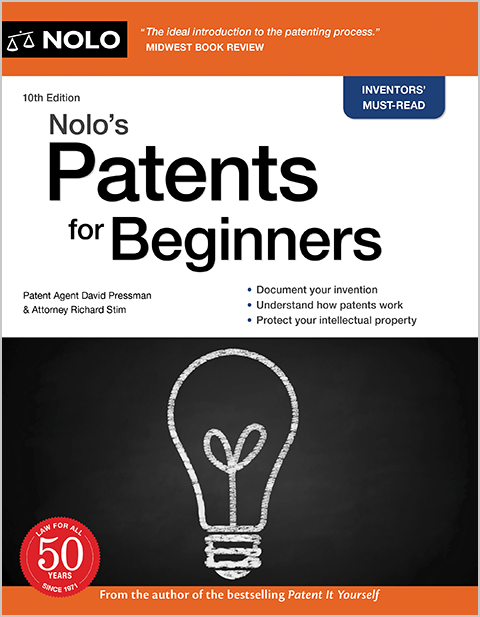
Do you have a great idea for a product? Do you toil away in an office, garage or basement lab day by day in the hopes of bringing a new widget to life? What will you do when it's alive and kicking?
Here's the primer every first-time inventor needs. Packed with detailed information and concise explanations, Nolo's Patents for Beginners defines what a patent is and what it can do for you. Step by step, it explains how to:
Nolo's Patents for Beginners provides sample forms and letters, resources and a glossary of terms. The 6th edition is completely revised to cover all changes in patent case law and updated regulations for inventors applying for a patent.
The underlying principle of patents is that our nation rewards people who create useful things that are not -obvious by giving inventors a monopoly over the sale and manufacture of their inventions. For example, in the 19th Century, one company controlled the manufacture and sale of all matches, while another company controlled the manufacture and sale of all safety pins. Matches and safety pins, just like paperclips and ballpoint pens, may seem obvious now, but a century ago they were novel discoveries and both of these items were protected by patent laws. Eventually all patents expire, and as a result, now any company can manufacture and sell matches and safety pins without seeking permission.
This chapter will introduce you to some patent basics and summarize patent standards. Since patents are a member of the intellectual property family, we will also introduce principles of copyrights, trademarks, and trade secrets.
A patent is a grant from the federal government that gives an inventor the right to exclude others from making, using, selling, importing, or offering an invention for sale for a fixed period of time. For example, Whitcomb Judson received a patent in 1893 for the zipper, and for 17 years, Judson alone was entitled to manufacture and sell this invention.
"Invention" has a broad meaning. It is any new article, machine, composition, process, or new use developed by a human. For example, in 1988 Drs. Leder and Stewart (on behalf of Harvard University) were issued the first patent for a new animal life form embodied in a genetically altered mouse. This new life form is an invention.
The patent right lasts for approximately 17 to 18 years, provided certain fees are paid. After the patent right ends, anyone can freely copy the invention.
A patent is a form of personal property and can be sold outright for a lump sum, or its owner can give anyone permission to use the invention ("license it") in return for royalty payments. A patent can also be transferred by gift, will, or descent under a state's intestate succession (no-will) laws.
There are three types of patents -- utility patents, design patents, and plant patents.
Utility Patents: A utility patent, the most common type of patent, covers inventions that function in a unique manner to produce a utilitarian result. Examples of utility inventions are Velcro fasteners, new drugs, electronic circuits, software, semiconductor manufacturing processes, new bacteria, new animals, plants, automatic transmissions, and virtually anything else under the sun that can be made by humans. This book is devoted primarily to utility patents.
Design Patents: A design patent covers the unique, ornamental, or visible shape or design of a useful object. Thus if a lamp, a building, a computer case, or a desk has a truly unique appearance, its design can be patented. Even computer screen icons can be patented. However, the uniqueness of the design must be purely ornamental or aesthetic; if the shape is functional and aesthetic, then only a utility patent is proper. A useful way to distinguish between a design and a utility invention is to ask, "Will removing the novel features substantially affect the function of the device?" For example, removing the carved wood design in the headboard of a bed would not affect how the bed functioned and could be protected as a design patent. On the other hand, a baseball bat and fishing rod may have pleasing designs but unless they have non-functional aesthetic features, their shape is purely functional and suitable only for a utility patent. (For more information on design patents, see Chapter 2, Section F.)
Plant Patents: A plant patent covers plants that can be reproduced through the use of grafts and cuttings such as flowers. These are referred to as asexually reproducible plants. (35 U.S.C. § 161.) The Plant Variety Protection Act covers those plants that use pollination (sexually reproducible plants). (7 U.S.C. § 2321.) Under some circumstances, utility patents can cover sexually and asexually reproducible plants. (For more information on plant patents, see Chapter 2.)
A patent gives its owner the right to sue infringers, that is, anyone who imports, makes, uses, sells, or offers the invention for sale (or an essential part of it) without authorization. If the patent owner wins the lawsuit, the judge will issue a signed order (an "injunction") against the infringer, ordering the infringer not to make, use, or sell the invention any more. The judge will also award the patent owner damages -- money to compensate the patent owner for loss due to the infringement. The amount of the damages is often equivalent to a reasonable royalty (say 5% of revenues), based on the infringer's sales. However, if the patent owner can convince the judge that the infringer acted in bad faith -- for example, infringed intentionally with no reasonable excuse -- the judge can triple the damages and make the infringer pay the patent owner's attorney fees. (For more information on patent infringement, see Chapter 8.)
Patent rights extend throughout the entire U.S., its territories, and possessions. Under international treaties, the owner of a U.S. patent can acquire patent rights in other countries by filing corresponding patent applications abroad as outlined in Chapter 9. Congress derives its power to make the patent statutes from the U.S. Constitution (Art. 1, Sec. 8). The statutes, in turn, authorize the PTO to issue its Rules of Practice and its Manual of Patent Examining Procedure (MPEP).
An inventor applies for the patent by filing a patent application, a set of papers that describes an invention. The Patent and Trademark Office (PTO) is a division of the Department of Commerce. A patent examiner at the PTO must be convinced that the invention claimed in the application satisfies the "novelty" and "nonobviousness" requirements of the patent laws.
The novelty requirement is easy to satisfy: the invention must be different from what is already known to the public. Any difference, however slight, will suffice. In addition to being novel, the examiner must also be convinced that the invention is nonobvious (or unobvious). This means that at the time the inventor came up with the invention, it would not have been considered obvious to a person skilled in the technology (called "art"). Unobviousness is best shown by new and unexpected, surprising, or far superior results, when compared to previous inventions and knowledge ("prior art") in the particular area of the invention. In addition to being novel and unobvious, utility inventions must also meet other legal requirements. More on this in Chapter 2.
We discuss the patent application process and the PTO in more detail in Chapters 5 and 6, and information about the PTO can accessed online at www.uspto.gov or by writing to the Commissioner for Patents, Washington, DC 20231.
Until recently, utility patents were granted for a period of 17 years, assuming required maintenance fees were paid. However, as a result of a change in patent laws, utility and plant patents issuing from applications filed after June 7, 1995, will expire 20 years from the date of filing. However, certain utility patents will be extended to compensate for the following:
In addition, patent rights may be extended for certain products whose commercial marketing has been delayed due to regulatory review, such as for drugs or food additives. (35 U.S.C. §§ 155-156.)
The term for design patents is 14 years from the date the patent is issued (the "date of issue").
From the date of filing to date of issuance (the "pendency period") the inventor has no patent rights, with one exception: if the application has been published, the applicant may later seek royalties for infringement during the post-publication pendency period. In any case, when and if, the patent later issues, the inventor will obtain the right to prevent the continuation of any infringing activity that started during the pendency period. Patents aren't renewable, and once patented, an invention may not be repatented.
Patent rights can be lost if:
In short, the patent monopoly, while powerful, may be defeated and is limited in scope and time.
Intellectual property refers to any product of the human mind or intellect, such as an idea, invention, artistic expression, unique name, business method, industrial process, or chemical formula. Intellectual property (IP) law determines when and how a person can capitalize on a creation. Over the years, intellectual property law has fallen into several distinct subcategories, according to the type of "property" involved:
Trademarks are the most familiar branch of intellectual property law. On a daily basis, everyone sees, uses, and makes many decisions on the basis of trademarks. For instance, the purchase of a car, an appliance, packaged food, a magazine, computer, or a watch, is based, at least to some extent, on the trademark.
In its most literal meaning, a trademark is any word or other symbol that is consistently associated with a product or service and identifies and distinguishes that product or service from others in the marketplace. A trademark can be a word (Kodak), a design or logo (the Nike swoosh), a sound (the Tarzan yell), shapes (the truncated, contrasting, conical top of Cross pens), colors (and color combinations), and even smells. The term "trademark" is also commonly used to mean "service marks." These are marks (words or other symbols) that are associated with services offered in the marketplace. The letters CBS in connection with the broadcast network are one example of a service mark. Another is the emblem used by Blue Cross-Blue Shield for its medical insurance services.
The trademark owner can prevent another business from using the same or a confusingly similar mark for the same or similar goods. Owners of famous marks can prevent the use of similar marks that dilute or tarnish the trademark's image, even if these uses are not on similar goods or services.
Contrary to popular belief, trademarks do not have to be registered for offensive rights to be acquired (although registration can substantially add to the trademark owner's rights). Trademark rights are acquired by the first person to actually use the trademark in commerce or file an intent-to-use (ITU) application to register the trademark and subsequently use the mark in commerce. Actual use in commerce means shipping goods or advertising services in interstate or foreign commerce that bear the trademark.
Trademarks are useful in conjunction with inventions, whether patentable or not. For example, consider the Crock Pot and the Hula Hoop. Both of these products were unpatentable, but the names of the products were protected under trademark laws. As a result of advertising consumers sought out the trademarked products and not those from competitors. In short, a trademark provides brand-name recognition to the product and a patent provides a tool to enforce a mono-poly based on functional features. Since trademark rights can be kept forever (as long as the trademark continues to be used), a trademark can be a powerful means of effectively extending a monopoly on the market for the invention long after the patent has expired. For example, the Scotch-guard process for protecting carpets was invented by Patsy Sherman & Samuel Smith and patented in 1973. Even though other companies may now copy the process, the Scotchguard trademark is still synonymous with quality carpet protection and gives the company an edge among consumers who want products to protect carpet and fabrics.
For more information on federal trademarks, access
the U.S. Trademark Office at www.uspto.gov, or review
Trademark: Legal Care for Your Business & Product Name,
by Stephen Elias (Nolo).
In this section copyright law is explained and distinguished from patents. Information is provided about acquiring and maintaining copyright. Some specific types of works that are covered by copyright are books, poetry, plays, songs, catalogs, photographs, computer programs, advertisements, labels, movies, maps, drawings, sculpture, prints and art reproductions, board games and rules, and recordings.
Copyright is a legal right given to an author, artist, composer, or programmer, to exclude others from publishing or copying literary, dramatic, musical, artistic, or software works. A copyright covers only the author's or artist's particular way of expressing an idea. While a copyright can provide offensive rights on the particular arrangement of words that constitute a book or play, it can't cover the book's subject matter, message, or teachings. For example, you are free to publish any of the ideas, concepts, and information in this (or any) book, provided that you use your own words. But if you copy the specific wording, then you have infringed the copyright on this book.
To obtain a copyright, a work must be "original," not merely the result of extended effort. For example, a telephone company that compiled, through much work, an alphabetical directory of names and addresses could not prevent another publisher from copying the directory, since it had no originality. Certain items, such as a title, short phrase, lettering, an idea, a plan, a form, a system, a method, a process, a concept, a principle, and a device can't be covered through copyright. U.S. government publications, by law, aren't covered by copyright and may almost always be freely copied and sold by anyone, if desired. Copyright can't be used for a utilitarian article, unless it has an aesthetic feature that can be separated from and can exist independently of the article (known as the "separability requirement"). For example, copyright cannot protect a belt buckle but can protect a design that is affixed to the buckle.
The copyright springs into existence the instant the work of expression first assumes some tangible form, for example, once a song is recorded or a book is written. Copyright lasts for the life of the author plus 70 years, or for works made for hire, 95 years from publication or 120 years from creation, whichever is shorter. A work made for hire is one made by an employee in the course of the employment or by an independent contractor under a written work-made-for-hire contract. The copyright owner in a work made for hire is the hiring party or employer.
Registration is not necessary to acquire copyright protection but if it is accomplished within three months of the time the item is distributed or published, or before the infringement occurs, it may entitle the copyright owner to attorney fees, costs, and damages that don't have to be proved (called "statutory damages").
Copyright Notice. While no longer necessary for works
published after March 1, 1989, it's still advisable to place the
familiar copyright notice (for example, Copyright © 2004 David
Pressman) on each published copy of the work. This tells anyone who
sees the work that the copyright is being claimed, who is claiming
it, and when the work was first published. This notice prevents an
infringer from later claiming that the infringement was
accidental.
Things that are entitled to a patent are generally not entitled to a copyright, and vice versa. Assuming they don't have any aesthetic components, patents are exclusive for machines, compositions, articles of manufacture, processes, and new uses. On the other hand, copyrights are exclusive for works of expression, such as writings, movies, plays, recordings, and artwork, assuming they don't have any functional aspects. However, a few creations may be eligible for both types of coverage (see Computer Software sidebar, below).
In many areas, both forms of coverage can be used together for different aspects of the creation. For instance, in a board game, the game apparatus, if sufficiently unique, can be patented, while the gameboard, rules, box, and design of the game pieces can be covered by copyright. The artwork on the box or package for almost any invention can be covered by copyright, as can the instructions accompanying the product. Also the name of the game (for example, Dungeons and Dragons) is a trademark and can be covered as such.
There's considerable overlap here, since aesthetics are the basis of both forms of coverage. Design patents are used mainly to cover industrial designs where the shape of the object has ornamental features and the shape is inseparable from, or meaningless if separated from, the object. For example, a tire tread design and a computer case are perfect for design patents. However, a surface decal, which could be used elsewhere, is not.
Copyright, on the other hand, can be used for almost any artistic or written creation, whether or not it's inseparable from an underlying object, so long as the aspect of the work for which copyright is being sought is ornamental and not functional. This means copyright can be used for pure surface ornamentation, such as the artwork on a can of beans, as well as sculptural works where the "art" and the object are integrated, such as a statue. For instance, the shape of a toy was held to be properly covered by copyright since the shape played no role in how the toy functioned and since a toy wasn't considered to perform a useful function (although many parents who use toys to divert their children would disagree).
Compared to copyright, design patents are relatively expensive and time-consuming to obtain and the rights last only 14 years. However, a design patent offers broader rights than a copyright in that it covers the aesthetic principles underlying the design. This means that someone else coming up with a similar, but somewhat changed design would probably be liable for design patent infringement.
For more information on copyright, read
The Copyright Handbook, by Stephen Fishman (for written
works),
Copyright Your Software, by Stephen Fishman (for software
and computer-related expressions), and
Web and Software Development: A Legal Guide, also by Stephen
Fishman. Nolo publishes all three books. Also, the Copyright
Office, Washington, DC 20559, provides free information and
copyright forms at www.loc.gov, or call 202-707-9100.
Here we provide a basic definition of trade secrets, distinguish trade secret protection from patents, list the advantages and disadvantages of trade secret versus patenting, and explain how to acquire and maintain trade secret rights.
A trade secret is any information, design, device, process, composition, technique, or formula that is not known generally and that affords its owner a competitive business advantage. Examples of trade secrets are a chemical formula, a manufacturing process, a "magic-type" secret (such as techniques used to produce laser light shows and fireworks), and a recipe. Since these types of information and know-how go to the very heart of a business's competitive position, businesses expend a great deal of time, energy, and money to guard their trade secrets.
The trade secret owner need only take reasonable precautions to keep the information confidential in order to acquire and maintain trade secret rights. Also, an employer should have all employees who have access to company trade secrets sign an agreement to keep the information confidential. Over the years the courts have devised a number of tests for determining what these reasonable precautions should be and whether a trade secret owner has taken them. Most states now have a statute that makes the theft of a trade secret a criminal offense as well as the basis for civil lawsuit (for instance, the Uniform Trade Secrets Act, California Civil Code § 3246 et seq.). Moreover, there is now a federal statute for the same purpose (Economic Espionage Act, 18 U.S.C. § 1831 et seq.).
Assuming that an invention has been kept secret, an inventor can rely on trade secret principles to enforce rights on the invention. If an invention is maintained as a trade secret and put into commercial use, the inventor must file a patent application within one year of the date the invention was used commercially. If the inventor waits over a year, any patent that the inventor does ultimately obtain will be held invalid if this fact is discovered. More on this "one-year rule" in Chapter 2, Section D.
When a patent issues, the public has complete access to the ideas, techniques, approaches, and methods underlying the invention. This is because a patent application must clearly explain how to make and use the invention. Since the application is printed verbatim when the patent issues, all of this "know-how" becomes public. This public disclosure doesn't usually hurt the inventor, however, since the patent can be used to prevent anyone else from commercially exploiting the underlying information.
The PTO treats patent applications as confidential so it is possible to apply for a patent and still maintain the underlying information as a trade secret during the patent application process, at least for the first 18 months. (See Section 4.)
As a result of recent legislation, starting with applications filed November 29, 2000, every pending patent application will be published for the public to view 18 months after its filing date (or earlier if requested by the applicant). The only exception is if the applicant, at the time of filing, informs the PTO that the application will not be filed abroad. If the patent application is published but is later rejected then the inventor is in the unfortunate position of having lost both trade secret and patent rights.
If an inventor files a patent application on an invention and the inventor wants to keep it as a trade secret if the patent isn't granted, the inventor will have to take affirmative steps to withdraw the application before publication to prevent loss of the trade secret rights. (See Chapter 6.) There is one advantage to publication in that an applicant whose application is published may obtain royalties from an infringer from the date of the publication if the application later issues as a patent. The infringer must have had actual notice of the publication. This can be accomplished by sending a copy of the publication to an infringer.
Some people choose trade secret rights over a patent, assuming it's possible to protect the creation by either. Let's look at some of the reasons why:
There are many circumstances in which the trade secret rights have important disadvantages. In these contexts, using patent rights is essential.
The main reason that trade secrets are often a poor way to cover the work is that they can't be maintained when the public is able to discover the information by inspecting, dissecting, or analyzing the product (called "reverse engineering"). Because very sophisticated analytic tools are now available, most things can be analyzed and copied, no matter how sophisticated or small they are. And remember, the law generally allows anyone to copy and make anything freely, unless it is patented or subject to copyright coverage, or unless its shape is its trademark, such as the shape of the Fotomat huts.
Strict precautions must always be taken and continually enforced to maintain the confidentiality of a trade secret. If the trade secret is discovered legitimately, or by any other method, it's generally lost forever, although the trade secret owner does have rights against anyone who purloins the trade secret by illegal means.
A trade secret can be patented by someone else who discovers it by legitimate means. For instance, suppose an inventor creates a new formula for a hair treatment lotion, and someone who has never even heard of the lotion comes up with the same formula and patents it successfully. She can legitimately sue and hold the inventor liable for infringing her patent! Under new legislation, an inventor who has used a process has a defense to a claim of infringement by a second inventor who obtains a patent on the process, provided that the first inventor's use was over a year before the patent's filing date. (See Chapter 8, Section D.)
For more information on trade secrets, consult
Nondisclosure Agreements: Protecting Your Trade Secrets and
More, by Richard Stim and Stephen Fishman (Nolo).
Unfair competition includes any number of devious methods by which businesses act unfairly, including false advertising claims, false endorsement of products, deceptive packaging, or dishonest promotions or marketing. The scope of unfair competition law is nebulous in the first place and is regularly being changed by judges who make new and often contradictory rulings.
The primary federal law used to enforce unfair competition law is the federal "false designation of origin" statute (15 U.S.C. § 1125(a)). If an injured party can prove that a business has engaged in unfair competition, a judge will issue an injunction (legal order) prohibiting the business from any further such activity or defining what the business can and can't do. Further, the court may award compensation (monetary damages) to the injured business (that is, the business that lost profits because of the public's confusion). Unfair competition occasionally intersects with patents. For example, a company may advertise it has a superior patented process for roach killing when it does not have a patent. A competitor can sue to stop the false advertising.
Here are summaries of important legal or procedural changes that affect the latest edition of this product.
Whats New in the 6th Edition of Patents for BeginnersOverview of What''s New
The new edition includes information about the termination of the Document Disclosure Program, additional information about the EFS-WEB electronic filing system, new case law, including: KSR v. Teleflex (nonobviousness) , Qanta v. LG (patent exhaustion), eBay v. Mercantile (injunctions), and In re Bilski (software patents). The new edition also includes new regulations regarding filing procedures and changes to Petitions to Make Special.Who Needs the New Edition?
You Need the New Edition If:you want the latest case law, regulations, and filing procedures.Chapters Most Affected
Chapter 6: Patent Prosecution and the PTO has the most changes, including electronic filing rules and regulations regarding patent prosecution.Forms That Have Changed
The USPTO forms included in the book have all been updated to their current version.